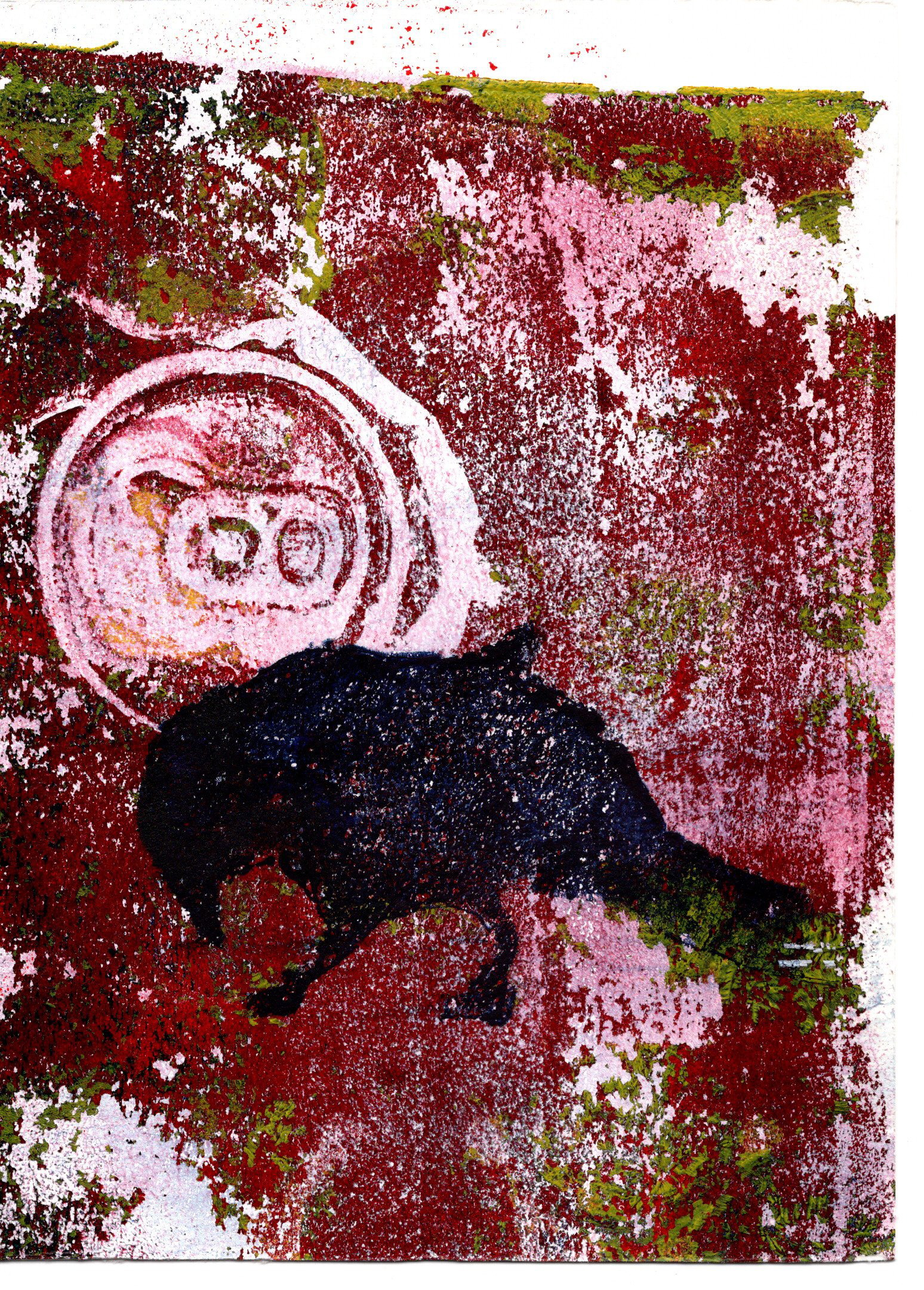
(Cover Art — Crow 0005 gel print by Anita Dime)
The Poetry
J.R. Acero
KNOWN & KNOWING
We are two strangers who happen to know
the layout of each other’s childhoods;
the origins of every debt we owe;
the pace and gait our boots trace in the woods;
how frozen tongues evolve into falsehoods;
what dreams were dressed atop that violet hill;
the greenest corners where our laughter stood;
our shapes dissolve into a single spill;
that compromise has costs we loathe to bill;
how neither of us wants to take the blame;
that partnerships are just a force of will;
that being known and knowing aren’t the same.
The violet wilts away its heavy hue.
We’ve been two strangers longer than I knew.
Philippa Ancla
DANCE FOR YOU
Call the new girl a dog. Laugh at her
knee length skirt and void black tights.
She’ll dance for you to prove you wrong.
When you want her back, burn your knees on the carpet.
Tell her you’d move heaven and earth for her.
She’ll dance for you until you step on her toes.
Leave the boys at the bar on the next night out,
then gasp, between kisses, that you don’t deserve her.
She’ll dance for you if she’s feeling bold.
Pay her enough to leave her attitude at the door,
and she’ll dance for you. She’ll dress like
a Rotten Tomato at the office Christmas party.
She’ll let you buy her a Starbucks to be polite.
When your son proposes to her, insist on a ball.
Even if he’d rather a moment alone,
she’ll dance for you in that stunning dress,
she’ll let you live through her for a night,
because the best kind of dancer does what she’s told.
YOU’RE THE CHEESECAKE AN ORPHAN
JUST ORDERED WITH HER
FIRST CORPORATE PAYCHECK
I’m not sure if it was the dried edible flowers,
or the little lakes of mango curd on top,
or the obscenely large plate I was placed on,
or how perfectly round I was when I could have been sliced.
But she didn’t pick up her spoon for a few minutes.
She retracted her hands from the table,
sandwiched them in between her knees, I think.
And when she looked at me, her eyes swelled with tears.
Jane Ayres
BORROWED LIGHT
two spoons
an owl
the evocative smell of wet towel
items that went missing from the office fridge
(was it a bird?)
and
(in that split second)
you know
you just know
CARNAGE IN THE CHEESE SHED
changing the ending
wrestling trauma
into your fiction
(wasp bubbles)
i want to know
am i still the last girl?
Acacio Barros
BECOMING A POET
Walking my dog, I hear
a podcast host ask his guest:
“When did you become a poet?”
I mull over how to uncover
a poet. Is the horny
teenager trying to get
into Patricia’s pants, his verses filled
with red roses and blue violets,
a poet? The caffeinated student
flunking math, his sentences enjambed
with equations and sorrows? Gina,
drying her tears between
the lines while searching for words
that rhyme with hole—her boyfriend
drooling over Patricia? My father-in-law
reciting poems about men
from Nantucket? Must poets write
sonnets? Perhaps you’re finally a poet
when someone wonders
“When did you become a poet?”
I forgot a poop bag.
Ruth Bavetta
TRIANGLE
In the sensation of silk
there is something of the worm,
dropped alive into boiling water.
It lies behind the lace of Sicily,
the satins of Manhattan, the patterns
under the power sewing machines,
in the threads and scissors,
shears and seam rippers,
in the dark hours and slitted days,
in the locked factory door.
Rose Mary Boehm
WHERE YOU ARE NOT
We have no past yet
in these streets of alien sameness
and it’s the wrong ocean
that leads me away from where you
are looking for me in places
where we encrusted our lives.
At night I cannot feel an imprint of your presence.
For lunch a solitary plate, no rice.
First morning tea a hurried necessity
instead of our ritual celebration.
The toothbrush in its beaker
can’t cheat me into thinking
you will be home tonight.
And so instead of looking for you
where we’re both still strangers,
I stretch to meet you where you search
for our love’s signature.
Isabelle Bohl
STOKING THE KILN
They say I must experience
the rush of stoking
but because they caution me
to tie my long hair
remove any highly combustible clothing
and mind my plastic eyeglasses
I hesitate
yet they coax
open the furnacing crucible.
I toss in three pine logs for a quick burst
six oak for a slow burn
until black smoke billows out the back
rises into the Minnesota sky.
Winds carry weather eastward
where smoke molecules
now diluted and imperceptible
find your Adirondack mountain
settle on your shoulders
your diaphanous temples
the way wood-burning scent
permeated every corner of our cabin
and lingered on our skin
yet failed to preserve us.
Signal
I am still here.
Satori Boularès
SELF-MYTHOLOGY BLUES
Greece Town Mall at 8pm. Friendly’s Mint Chocolate Chip Monster Mash Sundae. Climbing up the walls and falling into a pile of our stuffed animals. Fingerprints on linoleum. Latchkey kids with unlimited internet access. My brother is my very best friend. Calling 911 by accident. Calling 911 on purpose. The concept of being a child who knows nothing. Being the child who has always known. Being the child who always knew even when she didn’t.
Watching porn at age 8. Lesbians in a sauna. A little man dressed like the devil eating out a bombshell blonde. Fantasizing about giving head to my 4th grade crush. Wet spot on my Justice Day-of-the-Week panties, wearing Wednesday on a Sunday, always three steps ahead. Double D’s in 6th grade gym class. Dress coded in a matching outfit, the other girls got away without a warning. Voluptuous as fuck in lunch detention. Getting the up and down from The History Teacher. The History Teacher’s hairy fingers on my shoulder while he talks about The Flappers. The concept of being mature for your age. Being mature for your age. Going home and writing fanfiction on the internet. God, the girls are gonna love this one.
Legs spread on the Blue House hallway stairs, hands down my pants near the principal’s office. Sharing earbuds listening to Infinity on High. Sharing earbuds listening to Use Your Illusion I. Sharing earbuds, listening to anything to drown out the sound of three sheets in the wind. Flossing pubes out of my teeth. Getting pubes thrown at me by Sammy in the art room. Overdosing on the art room floor before first period. Cough syrup hangover in the 8th grade. Teaching all of Green House how to mix that good sizzurp. Marie Curie of the medicine cabinet. Decorative Višnja from Dubrovnik given to me by my grandparents. Taking sips of the Višnja and it tastes like shit. Dreaming of a future in mixology.
Inhaling cheap spliffs off a guy named Tweaker Jones in the abandoned factory in Churchville. Coughing up blood in junior year APUSH. Teacher with The Fuckass Bang telling me to stop crying in APUSH. Naming all the presidents in chronological order in APUSH and getting an award! Having a panic attack in the changing room during fall play. Who could’ve guessed, typecast again! Popping an Oxy and listening to King Crimson. Snorting an Oxy and getting into an argument with my boyfriend’s father. Homoerotic Female Friendship Gone Murderous. Nicotine and caffeine just like my daddy. Making dua during Ramadan. Manifesting a horrible fate for me and all of my friends. Blood Red Dress to the honors society induction. Only my mother claps for me.
Sammy starts calling me ISIS so everyone starts calling me ISIS. I call Sammy Pubes and everyone still calls him Sammy. A teacher mistakenly calls me ISIS. Pictures of pubescent dick in my DMs. The carpet did in fact match the drapes. A boy across town sends me his tapeworm in a jar. A boy across town calls me the most beautiful girl he’s ever seen. That boy across town is found dead with a bottle full of Oxy. Everyone pretends to know that boy and still nobody takes me seriously. The boys from Theory of Knowledge put me in a Minecraft Rape Chamber. Sneaking off to RIT for a sneaky link. Covid-19 kills my great grandmother but saves me from the knife. Hammurabi’s code written on the inside of my forearm. My brother is my very best friend. I leave for college and nothing feels more comfortable than Wednesday’s underwear on a Sunday.
Vodka Crans that are 70% vodka. Popeyes Chicken Sandwich as the cure for a hangover. Haitian guys from Brooklyn roll me blunts with real papers. Ripping blinkers in the bathroom. Ripping bong in the nature preserve. Ripping from a pipe in the empty bedroom where glass was shattered and cut Bella on the arm. Ripping through my skin with a razor blade. Ripping the seams off my dresses. Ripping up letters from the boy down the hall. Ripping insults at the top of my lungs. Snorting lines. Snorting snot back up behind my KN-95 in Lecture Hall 3. Snorting and laughing and riffing until Four AM.
Falling in love. Getting heartbroken. Falling in love. Getting fucked in a playground twisty slide. Sorry kids! Getting fucked in a basement on two Rent-A-Center couches pushed together. Ripping off Wednesday’s underwear, bloodstained. Eye Movement Desensitization and Reprocessing. Graduation. The undercooked rice from Chipotle causes more emotion than me walking the stage. Well, fuck my Bachelor’s Degree! Moving across the country. Getting gutted like a fish. Love doesn’t know me. Burning bridges and inhaling the smoke. Burning bridges just to inhale the smoke. A man across the street hollers, “Smoking kills!” and I shout right back, “So do I!”
Decorative Višnja from Dubrovnik that I purchased all by myself. Taking sips of the Višnja and it tastes like falling in love. A girl six years younger than me calls me Mom. Mommy’s little girl at 24. A mommy to 90 at 24. The only co-sleeping I approve of is that with my cat. Claiming to have given birth to my cat. Yes, her fur gave me horrific heartburn during gestation. Going to the hospital for horrific heartburn. Going to the hospital for a head injury. Going to the therapist for a moral injury. You’re so vain—I bet you think this blame is about you.
An 18-year-old boy tells me I saved his life. I tell the 18-year-old boy that he saved mine. Early summer sun hot on Wintergreen skin. Olive and caramel and chocolate. Everything is romantic. I smile and I mean it. I smile and I can’t help it. I smile until I cry. Happy tears to offset the overwhelm. I never knew it could be so simple. Glasses with untinted lenses. Rose filter on my lips. Puff puff pass on my balcony. Some things will always stay the same. We laugh until we cry. We cry until we laugh. We laugh and cry and cough because our lungs are charred. I finally wear Sunday on a Sunday. I am exactly where I need to be.
Ingrid Bruck
THE MINER
(After: Emily Dickinson’s 406: Some—Work for Immortality
Last Line: One’s—Money—One’s—the Mine— )
One’s—Money—One’s—the Mine—
for this crone body softening with age,
which is which?
age is the wave
of time rolling forward,
not the essence of water
it’s a hungry woman
begging for bread to eat,
not knowing how to plant or grow
it’s the Amish apple tree in a local orchard
frost bitten in April, fruit missing,
not last year’s bumper harvest
which is the whole?
which is the part?
how can a Miner find Gold?
the Miner digging for Gold
listens in the presence of rough, hard, cold earth
sings to the absence of smooth, soft, hot flesh
how can she tell the difference
between a raindrop in a lake
and a lake full of raindrops?
Jeff Burt
ON THE IMPORTANCE OF ANCESTRY
Lights turned off one night in October
my brother and I lay in bed questioning the motive
of our grandmother for claiming we had some French
in our blood, some President Roosevelt, too,
when we both knew she was all Irish.
To add a touch of elegance, my father said,
put some ornamentation on her history,
because her own grandmother had come to the states
from the potato famine in Ireland—they were poor,
relatives had starved. Even me, my father said,
I thought my skin was dark because the peat my ancestors dug
stained the skin so deeply it passed down generations.
Not all of us come from royalty, kings and warriors,
but we all want our flesh and blood respected.
When he left, we laughed. We imagined kids
from school absorbing genetic change,
the purple bruises on Anthony’s arms stains from picking grapes,
Sheila’s flat red complexion from the bricks her father worked,
white infield lime for me, pond scum for my brother,
blue lawnmower smoke for all the lucky kids of summer.
BROTHERS
cuz that’s the way I like to start the morning he said opening windows
to feel the damp cool air flood into the house whisking the hairs on his legs.
We’d eat standing up packing our coolers for the work day in the rows of corn,
a rain jacket worn not for rain but to ward off the saliva from the panting cornstalks.
He’d eat one bowl of Cheerios before he’d brush his teeth, then a half-bowl after,
like a horse had the smell of oats on his breath, and true, he was a draft horse,
pulling the crew into working the fields and breaking the tassels,
setting the pace, a man among teenagers that made my mother proud,
who, after her read of scripture, had assembled the sandwiches and carrots
and sticks of celery the same way day after day for eight summer weeks,
as we wrestled on our clothes, she reminding us life was not all baseball cards
and box scores, there was war and suppression of blacks and women.
It wasn’t work that made her happy. It wasn’t the money we earned.
It was her two boys rising in the dark and entering the scant light
before the sun would rise, who bullied their way through blocks of darkness to care,
to care for what they’d never cared for, seeds, a crop, furrows, a field, each other.
Raymond Byrnes
WHAT CAN I SAY?
Mary felt she couldn’t make the trip,
let alone the climb, so I offered to carry
the urn to your engagement ledge in
the Blue Ridge above Harpers Ferry.
It should have been a simple trip
to drive from Dayton, get a room
hike up at dawn, weep, tip out the
ash and return, but the urn is gone.
It was in my backpack behind the
rear seat, concealed by the tinted
glass smashed away last night under
a bold Patrolled By Security sign.
Where are you now? In an Exxon
trash can? Strewn along a Highway 7
shoulder? Settled to eternal rest
beneath a Shenandoah River bridge?
Marietta Calvanico
FEBRUARY STRANGELY PROMISES
Nearly Alice blue breaking past white
in glinty sun the tide pulls out bares
shells that squirm and algae-slimed rocks
that kiss wet sand and echo time
ungracious gulls swoop overhead
cawcawcawing loudly long and
search through slanted rays to feed while
the tide pulls out and begs tomorrow
the tide pulls out and hails the sky
hello Evening Star! And waves to Mars
moody magical warring man
sorry for poison sorry for sadness
Sandgrit pockets full of shell bits
chasing while the tide pulls out
February strangely promises
something ruptured balmy found
fourteen weeks til into June
the tide pulls out and blames the moon
Allison Camp
A CIS STRAIGHT WOMAN BECOMES POSSESSED BY A
QUEER LOVE STORY BETWEEN TWO HOCKEY PLAYERS
I don’t even like romance, and yet –
maybe I’ve never thoroughly adored a love story
all desire, passion, longing, and lacking a female body.
No point of comparison to myself, no-body as an object.
Why am I gripped in an emotional chokehold?
I don’t even like romance, and yet –
Masculine vulnerability. The nakedness of need. Tender men
with tears stealing down their cheeks. Undeniably alluring,
all desire, passion, longing, and lacking a female body.
A chord has been struck, created with lighting, angles, performance,
that reverberates through my brain, vibrates like a bell.
I don’t even like romance, and yet
I can’t stop the echoes. Hungry hands,
ready mouths, moans slipping through lips –
all desire, passion, longing, and lacking a female body.
My mind replays the stolen glances, teeming with yearning
and the thirst for more but with no power dynamic of the sexes.
I don’t even like romance, and yet –
give me desire, passion, longing, lacking a female body.
Sarah Carleton
SCENT AND SENSIBILITY
I
Muddy linoleum and unfolded laundry
are okay when a bar of lavender soap
awaits, corners sharp, etched logo
still readable by fingertips. The scent
bakes in the bathroom drawer and pours out
when I open it, setting free a nineteenth-
century domestic in an ironed apron
who shakes fresh linens over the bed.
II
On evenings when sills are dusted
and bookshelves pruned, I’m breathing
deeply till outside odors swamp the screens
—industrial cherry blooming from dryers
and slicks of pot smoke like a residue
of my 25-year-old self dancing in a bar,
glazed in whiskey, kicking stale-beer
stench from the floorboards.
III
New Year’s Eve, I hear pops and shrieks
from down the street and smell gunpowder
at the edges of our closed windows.
I’m in bed by nine, out of the line of fire,
piling pillows around me like an earthwork.
I wake to hard sun and branches bouncing.
A clear front has swept in with an open
smell like a blank page on a silver tray.
Wendy Taylor Carlisle
JUST BECAUSE YOU’RE STANDING IN THE GARAGE,
DON’T MAKE YOU A CAR
Everything I know about beauty I learned in Texas—
plucking, waxing, buffing, lifting, cupping, colorists,
coiffeur, Botox, Restlayne, where to locate
tailors, Yoga teachers, upscale trainers.
In Texas, I discovered couture, became
acquainted with high heeled Louboutins
Gucci purses, plush linings and stingy lunches.
I mastered lavish in Texas, land of excess,
where I was taught being taut, by women
who never aged, who gracefully welcomed
compliments from strangers in Brioni suits,
and understood how to vanish
from piddling Texas towns, driving a Mercedes
wearing brand-new Lucchese alligator boots.
ELEGY
I don’t know where Phil ended up,
but he was on his way out,
when we visited him in his apartment
by the lake, on our way to Mayo
for my husband’s bad back.
Pictures show a man, vanishing but smiling,
grateful to be around to open his big door,
welcome us in. On our last visit,
he didn’t mention what he imagined
would persist of him. What remains to us
is a fuzzy phone image, a last picture
from our time together, everyone
smiling, joking with that lapsed Catholic Altar boy
about the everlasting.
For Phillip Dacey, 1939-2016
Rebecca Clifford
ON THE DAY THEY GIVE ME EARTH
I want no box between me and the worms
no embalmer’s liquor no fancy frock
it’ll be hard enough to explain this mortal deal
without having to worry if I’ve lipstick on my teeth
or if my slip is showing
Axe Cornwell
TOO EARLY IS NOT ON TIME ALSO
“…muscular citizens of a tomorrow that never came” – Joan Didion
when I was a tour guide
a German tourist scolded me
“too early is not on time also”
and I’d been so occupied with lateness
I’d missed this whole dimension of not on time
like a neon diner sign lighting up at dawn
the ring testing my fiancé’s patience
I’d been debasing myself with
the promiscuity of prematurity
alighting on the platform one stop too soon
waiting on a future that did not arrive also
Joe Cottonwood
THREESOME
Silent amid sighs
I feel legs of silk
crawl tingly up my thigh
onto yours
Later I ask
did you feel it
Oh yes, you say,
like the tickle of God
I hope we didn’t crush it, I say
No, you say, it crawled up my armpit
and over the pillow
while you were so busy
Safe, our love and
we both like spiders
NIGHT WALK
A spotted fawn
wades the muddy brook.
As hooves sink into the muck,
as I blink—holy shit!—she transforms
into a human.
A little girl.
Barefoot.
Her nostrils, black.
Eyes like bullets in my light.
Her flesh pale, spotted red-brown,
fawn-color in reverse.
One breath-cloud by me
and she turns tail,
lovely white flag of alarm
and leaps across the babbling water,
climbs the steep mudbank
to the fallen tree. She’s gone.
John’s daughter,
shot at school one year ago.
What I saw—should I tell him?
AFTER GROWNUP
A sharp rap like a pebble on the glass.
Swainson’s thrush—of such lovely song.
Stunned, opening and closing her beak
on dirt below window. No sound.
At the clinic I meet Dr. Roth
because a week ago I was dancing.
Simply that. Dancing. Swinging my hips
when I hear (and feel) a sound
like ripping cloth. A shock of pain.
Collapse to the hardwood floor.
Roth says I have a muscle tear.
Gluteus medius. Pain in the ass.
Caused by degeneration all around.
Spine. Knees. Look at this MRI.
Like a ’47 Ford with a million miles.
“Use a cane,” he says.
I’m the guy who chainsaws, splits firewood.
Who climbs on his roof to nail shingles.
“You’re not that guy,” says Roth.
Nurse with a smile hands me a lollipop.
Back home, the thrush is gone.
Dog sniffs. I examine with cane for balance.
Scent of earth. One russet feather.
Dance, people. Now.
Dance.
Joe Couture
NAPALM
She was gasoline—
older, more expensive,
stabilized volatility.
Me, I was Styrofoam
and we both knew it.
We set out to set the world afire.
Instead, we scorched two kids,
left ourselves searing.
Unsalved.
Smoke-blind.
John Delaney

RECOVERY À LA NOTRE DAME
The inside’s restored; the outside needs work—
such has the salvage succeeded so far.
For the most part, the relics and paintings
were saved, and the famous rose windows, too.
Out of the fire, la flèche was made new.
Recovering from this catastrophe
could have therapeutic advice for you:
extinguish the obvious source of pain,
rummage through the rubble for the priceless
moments, memories that glow in the mess,
repair what has not been ruined, replace
what can be improved. Continue to bless
the process. But let caution be your guide:
the outside’s easy; work on the inside.
Dolo Diaz
THE GARDENER
His wife was drowning.
She refused surgery for years
for fear of not waking up,
and he respected that.
But she was drowning.
So, she did get the valves—finally,
when the drowning became worse
than not waking up.
They came from a pig, he says,
raising his eyebrows.
She no longer drowns,
but she faints occasionally.
She’d rather have that.
She worries about what they may find,
so she will go with the fainting,
at least for now, he says,
turning to prune
the white rose bush.
Before I walk away,
I see the bush shiver
beneath the tenderness
of his hands.
Clive Donovan
SHE SMILES AMONG HIS FILES
In his never-emptied in-box
On the desk her picture lingers,
Nestling with memoranda,
Notes of passwords, keyboard short-cuts.
He picks her up, caresses her,
Thinking to frame that face some day,
Promote her to the out-tray then;
An oval shape, clean sheet of glass,
Taped, tacked, her image fixed at last,
As she deserves, this homeless girl.
He sighs and slides her vaguely back,
To drift among his jots and lists
Of things to do and things he’s missed;
The articles and recipes,
Ritual postcards sent by friends
On mini-breaks and honeymoons,
The pointless warranties he’s kept,
The oh so worthless guarantees,
That DVD of Season 3
They never viewed with fingers clasped,
The unsolved puzzle just beyond
His grasp…
ARE THEY ALWAYS HEROES?
When they show the token bones
Of fallen fighters
Broken
Warriors returned
On mighty shields
Our soldier boys
Boxed up as heroes
Shipped in procession
Back along the High Street:
Please?
Are they always heroes?
Do the trick-bombs and the bullets
Of the foe
Only pluck and kill
The best and bravest
Of our flowers?
Are there never any cowards, brutes,
Nor raping torturers
Among those few?
When the coffin
Wends
Its poignant way
Twixt aeroplane and grave
Is it never companied by ghosts
Of raving wives
And shrieking brides,
Children, mothers, fathers,
Drumming on the lid
Demanding
Why did you murder us
You rotten murderer?
Precious Ejim
RIPE FOR THE TEETH
even with my heart pumping profusely,
i feel it—
the panic rushing through my fingertips
like sewage pipes at night,
thick, unstoppable,
a black tide that keeps me awake
while the rest of the world forgets how to breathe.
i lie here with nothing but my thoughts and fears,
raw as open wounds,
realizing i am walking, barefoot and slow,
straight into the shark’s mouth.
i keep hoping for the soft give of a tongue,
the wet velvet that might cradle me,
instead of the sudden architecture of teeth—
those sharp, strangling blades
that know exactly how to tear.
most of all
i pray to be swallowed whole.
let the dark throat close around me,
warm and final,
pulling me down into the slow churn
where I might dissolve into something new.
anything but being chewed,
tasted,
and spat back out—
half-loved, half-ruined,
left blinking on the sand
with the taste of my own blood
still warm on my lips.
I would rather vanish inside the beast
than be returned to the bright, indifferent air
as proof that I was never worth keeping.
R. Gerry Fabian
PRECARIOUS GLANCE
The city bar is full tonight.
The pheromones are floating
like dust particles in sunlight.
The scents are languidly active.
Eyes meet.
A subtle smile is offered, received
yet not returned.
A coy ploy, perhaps.
Walk away from the group.
Eye contact again
and the smile is returned.
I order another drink.
And so, it unravels.
Alexis Rhone Fancher
SWEET
Baby, wake up! Jimmy shakes my shoulders. Tousles my hair. I rub the sleep from my eyes. It’s late, babe, he says. We gotta get on the road! I’ve been dreaming again about the desert. Its vast emptiness and sullen disposition. Please, Jimmy. Give me 5 more minutes! I snuggle under the duvet, put on my wanton face, try to pull Jimmy into bed. I don’t wanna go, I say. I had another one of those dreams. I want to elaborate, but Jimmy isn’t listening. He pulls the duvet off the bed. He knows what’s underneath. Here’s the thing. I’m not a slut, but I do sleep naked at Jimmy’s request. Easy access, he tells me. The duvet gone, my nipples harden. They’re sensitive and the air is cold. Jimmy runs his fingers back and forth across my aureolas, teases my nipples. You’d think I am a keyboard. I mostly do what Jimmy wants. His desires align with my own. One of many things we have in common. We are of one mind. Jimmy says it so often I believe him. Look, I’m as much a feminist as the next girl. But relinquishing one’s autonomy from time to time isn’t always a bad thing. I mean, under the right conditions, it can be hot. As in “our lusts align” hot. That’s how it is with me and Jimmy. He eases my black sweater over my head, past my neck, fits my arms into the sleeves. Jimmy helps me struggle into my skinny jeans, the ones that reveal my belly button, caress my hips. He pulls them up, zips, then fastens them. As usual, he “forgets” my underpants. He says naked on denim is hot. In the kitchen I make coffee while Jimmy studies the roadmap. Figure 2, 3 hours max, to get there, babe, he says. I fill the thermos, split what’s left between us. Add a little sugar to his cup. Stir it with my baby finger. Jimmy likes his sweet.
Vern Fein
CHEATING DEATH
Every second that ticks
is another nail in my coffin.
Keep on hammering.
I am not a frog.
I do not live in a pond.
I cannot croak.
I’ll never go to Israel.
Then I can’t cross
that Jordan River.
I will wear tennis shoes
or sandals or dress shoes.
I will never die with my boots on.
Poker is a game.
I’ll never cash in my chips:
I’ll hoard them all!
See that cowboy with the lasso?
If he gives me enough rope,
I won’t hang around.
I might be a radish or a flower.
When it’s time to go,
I’ll never be dead meat.
I have no unlucky number.
I can’t count the hairs on my head.
My number will never come up.
I won’t bite the dust,
May I always eat poppies
in Flanders Fields.
Flowers make me sneeze.
If I push up daisies,
there might be an earthquake.
I will not sidle up to the Reaper.
There will be no chance
I will brush up against him.
I will never go in that door.
I will ring the doorbell,
never knock.
I have kissed many.
My lips are sealed now.
No kiss of death for me.
I will specify my grave.
Please dig it five feet deep.
Never dig to six.
All my services will be free.
Give me no wages
for my many sins.
But watch out for the bore and the badger.
I guess, in the long run,
they may get me in the end.
Wendy Freborg
REMEMBERING BOB WEIR 1947-2026
(by Wendy Freborg 1947-?)
A tie-dye tribute on the Empire State Building
honored this icon of the recent past.
This final glow of color
will be extinguished for another tribute,
a tribute to whatever happens next.
The lights are going out on my era too,
all the world I was comfortable in.
We had our chance to boom.
That day is done,
now I am old and in the way.
The young will be grateful when I am dead.
Meg Freer
GEESE
Written with care in black marker
on the picnic table by the river:
Hi Michael
I MISS you!
An arrow emphasizes the second line.
A third line, sketched quickly,
ends with a period:
go home mom.
Only Michael and his mom
know what prompted him
to leave.
Two geese swim by and won’t stop
honking, one after the other,
like an old-fashioned bicycle horn.
Too comical for this situation.
I can only hope
Michael sees the message
and knows what he must do.
Mac Gay
ON NOT BEING A PIG
Totality means all one thing,
when all of the singing
equals one song and
all the words sound like
Om, that nap-inducing drone.
And wherever you are that’s
your home. So why don’t we
sing larger more often?
What keeps us in all tiny
boxes? Why focus on rocks
when there’s mountains, and
the bedrock that’s even larger?
Let’s close the deal on the merger.
Sometimes we seem on the verge,
yet the urge for the small is
all we can see in the moment.
So quit fretting and think like
a cloud. That erases all doubt
that you’re big. And relax,
being all is not being a pig.
CONCERNING TRUMP’S POST OF HIMSELF AS JESUS
Did Jesus ever smear makeup on,
or carefully comb over his dyed blond hair
before going out to heal the sick
or raise the dead? It severely
hurts my head to try and conjure
Trump as Jesus or Jesus as Trump,
yet beneath those 300 pounds
of blubber and all that bluster
is the heart of that poor buffoon
completely devoid of moral luster,
for he (little h) is the least of our
brethren and sisters. Recall Jesus
repeated that whatever you do
to the least, you do to Him too,
and how can you be more miniscule
than a buffoonish blowhard and bully?
Maybe God the Father created this overblown
yet microscopic fool just to send us to school.
John Grey
FEAR OF A BICYCLIST
Your bicycle.
Your rattling mechanized world.
Shows up at my house.
Waits for my glare to turn around.
Off the saddle,
you bump into my front gate.
Bounce up the path
toward the steps
where I stand,
barring the way.
Sorry, you can’t come in.
Not into my home.
Not into me.
Tuck your shirt in.
Fix your hair.
Get back on your wheels.
I don’t trust anyone
who moves like you do.
Wind-blown anarchy.
And especially
that sweat between your legs.
You skip.
You hop.
I can’t handle dynamism.
I’m not even sure about pleasurable.
Really, I’m not trying to weasel out.
All I’m saying is
when I was a boy
I never could ride a bicycle.
And you’ve been pedaling forever.
Balance and speed
against my toppling and hurting.
God help me,
if the word ever got out.
Evie Groch
WINDBLOWN
I stand in the bold breeze
and say to him,
May this sibilant whisper
find its way through my heart
to cooly caress your face.
Its origin I cannot vouch,
but my wish is that
it deliver to you sincere
sensations that soothe
your soul and send you
serenity.
And he says to me,
Wind exists because the sun
heats the Earth unevenly,
creating areas of low air pressure
and high air pressure. Low-pressure
areas are where warm air rises;
high-pressure areas are where
cold air is sinking, pushing down
on the air below it.
I look at him with pity,
discovering communication
isn’t our strong point and say,
You’ve blown me away.
Stephanie Hashagen
HAIBUN
(Adam and Eve Get Evicted and Make the Best of It)
They’d seen the snake a few times, but they’d never gotten a good look at it. They weren’t even sure if there were multiple snakes or if they were just seeing the same snake in different places. They might have paid more attention if they’d known snakes were something to worry about. It’s hard to blame them for that. Snakes were still new. Nobody understood how they worked yet. Later, Adam got a three-piece suit to cover his shame and an office job to cover the mortgage. He had an hour-long commute each way. Sometimes he thought about death when the drivetime DJs made prank calls. Eve had trust issues and complicated feelings about pregnancy. She was pretty sure Adam resented her, even if he never came right out and said it. She wondered what he’d wish for if his ribs were still made of magic.
Our first place had a
garden, but the landlord could
be a real asshole.
Zachary Huneycutt
BLACK WATER
They don’t appear in twilight
nor after scent of morning rain,
when the air tastes damp in light
of heat, and Florida’s tepid breath: a sign
unseen, evaporating over green
grass blades and the sun’s crass crime,
when spring and fall are shaved untread
like a dirty beard or clean-haired head,
and summer’s length lasts—to the end of time;
that’s when they slither soundlessly, when
dithery hot summer renews itself.
And chooses always this time to stay,
to become so unbearable
that dark illusions befall the days,
and atmospheric snakes take shape,
mirages on the empty road. Or
black water running from some hose
of the unknown, not prince but toad,
not the bright place where sanity grows,
but flowers dying in real fairytales.
And if that I only saw them forming from down the road,
might I as well have tasted toad?
Christine Jackson
EAST OF KYIV
We boot through heaps of twisted metal,
startle at rigid sleeping souls.
At abandoned farms, blood icicles drape
across crooked window frames.
One farm was mine, years ago.
Air hangs heavy from rotting food,
burnt flesh. I order burials under
a single rough-hewn cross.
Curls of black smoke dot the far horizon.
Russian missile attacks.
Captain! Vasilyi points. Ukraine pigs!
Man in a thin sweater, boy following,
same as my Fedir, a long, frayed coat
dragging across mud. Time slows.
Bristling with animal heat, Vasilyi kneels,
aims. My glove bats down his AK-74 barrel.
Time resumes.
Vasilyi spits, shoulders the cold weapon,
his look gutting me like a pork loin.
Supply trucks only whir in the muck.
We prep for bivouac. Arcs of tracer fire
slash wounds across the night sky.
Hunched in my tent, I scratch numbers
with a pencil stub.
At oh-two-hundred, drunk Ivor sags at his post.
I take his knife to the end truck, playing
my light over three sacks of rags in the back,
so-called Ukraini traitors set to die at dawn.
I slit tape from mouths and wrists.
They jump out and run.
Andreyi. One man’s face flickers,
gaunt with terror. I hand him a sack.
For Major Brovko, Kyiv air base.
intel packet, drone blueprints, Grach pistol,
Russian troop numbers, dates.
Brovko. Say it. He does.
In Ukrainian I say, be silent,
watch mud by the river,
run like hellfire to the base.
He nods, familiar, as am I.
Our ancestral blood
has nurtured this land.
He slips away
I breathe cold grief
for my Fedir and Tania,
fallen to war and
brutal winter.
The gasp of a boyhood
memory rises unsummoned,
a nearby wheat field
flowing smooth
in a late summer wind.
THESE TWO
Whistling autumn breezes sweep
into eaves across the night sky.
After daytime’s boisterous squeals
rooms upstairs settle into quiet.
He switches off the light,
and the living room goes dark around
these two, who fold into
a familiar embrace across the couch.
Draped against his arm, she fills her
mind with long-ago love, a pilot
in the shape of a spinning maple tree
seed too light to land or settle
but who spun her into mystic
flight during one long rainy spring.
He recalls whispers
over too many whiskeys
with a night blooming redhead
whose warm cloud of jasmine
and amazing cleavage lured
him to her walk-up.
These two bend into each other,
touch foreheads as if thoughts
could dam the treachery of time,
stop before a paper hole leaks dollar
bills or a lurking X-ray shadow
leads to machine blips at bedside.
Tonight, they dance
to a profusion of stars.
Pankaj Khemka
DOCKED
When I was a puppy
I accidentally pooped
on my owner’s Persian rug.
He flushed hard purple,
growled, bared his teeth—
snatched me up in inked arms,
took me out back,
and docked my tail
with the sharp bite
of his hatchet,
cauterized the bloody stump
with the glowing orange tip
of his cigarette.
After that, I never made a mess
in the house again,
never barked, never begged.
When my owner moved away
he left me behind
with the rest of the trash.
One day, when I was out
scavenging for food,
a man in a white van
threw a net over me.
Now I’m in some kind of purgatory
with a bunch of howling mutts
in cages – sometimes they disappear,
never come back. Today,
a little girl in pigtails came.
I licked her hand, rolled over,
let her rub my belly.
She turned to her mama, said,
He’s cute
but I want one
that can wag its tail.
Barbara Krasner
THE NATURE OF ADVICE
I dreamt last night of two doctors consulting
about my betraying bile duct. That I would need
immediate surgery. I wonder, fully conscious,
whether this dream is prescient. I don’t trust my bile duct.
I wouldn’t trust my gall bladder either, if I still had one.
I don’t trust ointments and topical treatments.
I don’t always trust medical professionals,
but I would trust my mother if she were still alive,
the way my son asks me what sickness he has,
and I tell him to look in the mirror. If his ears are red,
he has bronchitis. That’s what urgent care tells him,
but my diagnosis is faster and cheaper.
My mother called not feeling good a nishtgutkeyt.
I like the way that sounds, all Yiddish swish
with a hard-knock ending, like a door closing
against a harsh wind. I toss words of advice
into that wind and heed what sneaks back in
in my own voice.
Mark LaMonda
WHEN YOUR WIFE SAYS
JUST WEAR THE FUCKING HAT
Have you considered an umbrella?
Or are you one of those fellas
that thinks it’s too feminine?
You could wear gloves
and dangle them above
if, you can still dangle
and walk at the same time.
She could reposition the sun,
if only she were the son
of the one who made the sun,
so it won’t ever reside
on her husband’s stubborn, bald head.
Or just wear the fucking hat she bought you.
You don’t even need a comb
to put it back together
in the end,
just lick your palm,
brush the few strands back,
and live forever.
Laurence Levey
FALTER
In the fall,
fallen, falling;
those minutes
after sundown
the sky turns liquid,
hazy blue
I think of you
and the three things
you let down
your hair
your guard
and me.
Nancy Smiler Levinson
DOG MEETS DRAG QUEEN
A drag queen
butt-length blond hair
array of jingling bracelets
and draped in lime net dress
swoops across the floor
of Sunbeam Party Room
Valley View Assisted Living
lip synching Barbra Streisand
Don’t Rain on my Parade
Residents seated on stacking chairs
wheel chairs and fitted walker seats
watch eagerly or with vacant interest
or with no awareness at all but
viewing a fancy lady singing songs
A boxer pup sits off-side
gazing at the performer
then fixes her dark eyes
on a band of folk
perched near a window
while she displays
a face as quizzical
a human expression
an animal can convey
what the hell is going on here?
The drag queen
belts out the song’s final word
milking the high note
reaching for a rainbow
bracelets jangling elbow-ward
A smattering of applause
peppers the room
and little Miss Boxer stands
on all fours, making it clear
that she would put her front paws together
along with the audience
if only she could
Amanda London
WHAT MY BODY KNOWS
I don’t dance to feel beautiful.
I dance to disappear.
When the music intumesces, I slip out of myself—
out of the body he touched like it was his,
out of the skin that hasn’t felt like mine
since the night I forgot how to say stop
without choking on it.
Sad songs make it easier;
their ache matches mine,
makes it okay to hurt where no one can see.
I let my limbs move without permission,
like maybe if I become motion
he can’t find me in the stillness.
But he does.
Not in footsteps or doorways—
in the shape of a shadow when I’m alone,
in a voice behind me that no one else hears.
He’s nowhere, but I feel him
in the way my spine tenses
when someone walks too close.
In the bathroom mirror at night,
I look over my shoulder without meaning to.
He lives in the memory of weight,
the ghost of pressure on my shoulders, my legs, my shaking wrists.
Even now, years later,
my body flinches like it still remembers
what my mind is tired of surviving.
So I dance.
Harder.
Until every muscle burns
and every heartbeat drowns out his name.
Until I forget the shape of him
and only remember mine.
Until the pain becomes motion,
and the motion feels like leaving
without ever needing to run.
C. I. Marshall
TRYING ON MY OLDER SISTER’S
FREDERICKS OF HOLLYWOOD DRESS
I’m supposed to be babysitting my niece, my two nephews
on a hot summer day. I’m nineteen and home from college.
Maybe I was teaching them about theatre, how a costume
could embody a character or maybe it was more about
how a certain body in a certain dress could attract men
like flies to maple syrup. Whatever the lesson I taught
them that hot afternoon in that knicked and knob-kneed
tract house– they never forgot it. I marched into my
sister’s bedroom, pulled open the closet door, grabbed
a skimpy black number I’d seen her wear when Tom
McKay came by to pick her up in his RS 327 Camaro.
To tell you the truth, I was a shocked by just how much
of her breasts and bottom spilled out. I’d seen this dress
in ads in Teen Magazine. A woman model who looked
like my sister and it cost, like, $20.99 with free shipping.
I took off my T shirt and jeans, held the dress over head
conflicted by flaps of flimsy straps drifting senselessly
away from my seventy-five pounds of sticks and stones.
I peered around the crooked door frame to hear howling
coming from mouths of my niece and nephews. Racing
through the kitchen, two loops around the living room,
I dodged the six and seven-year-old boys who took on
the role of screaming roly-polies. Come to think about it,
maybe I wasn’t teaching then about costumes, acting nor
fashion but how anxiety can play itself out on the body,
how being a perfectionist can make you shiver in summer.
How I saw myself as a sow reflected in the cracked mirror
leaned up against
the chipped and peeling paint of my sister’s bedroom wall.
YOUR SEAM: YOUR SALVAGE: YOUR
FOUR BUTTON FLY
If only I could finger your bruised Adidas
on their split cowhide selves. Useless, if
a wayward wrench fell on them, useless
when a tire went wrong; rolled over them.
If I could wash your Oxford button-down,
its beige stripes, coarse cotton fibers failing
to slow down swift Bay winds on the warpath
as they whooped it up across Emeryville Flats.
If I could fuss over your straight leg Levi’s,
linger over faded halos of your kneecaps. Size
32 by 32; I say, Protect his legs from splotches
of anti-freeze. The plywood creeper presses on
your rail-thin back as you rally for a release line,
the mysteries of a Milan-made manifold. If I could
will your Hanes once-upon-a-time white T-shirt to
myself, I’d surely make of it a hood. Be buried in it.
Smell forever after the sweat of you, saturated in
each selvage edge of you. Neck of the shirt stretched
by yank and yank over your head: what a head it is!
If I could hear you once more at midnight, imagine
you allowing your faintly-white boxers to fall onto
the floor, their sag of a waistband, leg holes pilled
from the rub, rub against your thighs. You tucking
them into your Levi’s, hiding them as I do the sharp
hiss sideling up to my brain. Hear it turn into holy
songs of the season. See it turn again to crisscross
mid-length over my Magellan map of missing you.
Anne McCulloch
CROWS NEVER FORGET A FACE
I currently worry that my husband dies
on the leather sofa
watching another foreign language tv series
at 5 am on a Saturday morning.
There is always trepidation
when I wake alone,
three hours later, breath held,
peeking down from the mezzanine.
I worry my daughter
will swallow her boyfriend’s Percocet
and die
or at best be back in A&E.
I used to worry she would throw
herself out the window
of our top floor townhouse
or cut herself badly –
even with a pencil sharpener blade –
which she did anyway.
I worried yesterday that our two Shorthair Orientals
will have their eyes pecked out by crows
as they dive bomb them
and shriek
crows never forget a face.
I constantly worry
I will be scammed out of all my money
in a private nursing home
beside a dried-up river, beech trees bare in winter
when I approach my mid-eighties.
Recently I worried that my oldest friend
has literally
disappeared.
She stopped talking to me.
I have theories.
My other friend
who remembers every seed she planted
forgot our lunch date.
Maybe I will die alone
or miss the 26 bus.
The crows will remember.
Aaron McGuffin
EXCAVATING PRESSURE
Let’s start with man.
Man in a Waffle House.
Man holding a mop at a difficult angle
that made his four-eleven frame
sizzle like hot-coal bacon.
His ankle-tracker
clanking the sides of the sink
as he stands in its basin
milking the syrup of feces
from the smudge-clogged bilge of the women’s toilet.
Damn that daily special.
Let’s go next with woman.
Woman in a Waffle House.
Woman with an urge
who pole-vaulted her lazy blond hair
and Cryptic Wood White butterfly tattoo
into that circus
of commotion.
Pulled down her pants
and bore down to pee,
her high heels
sloshing merrily
in the overflow effluent.
Stared up
at the stall-taped ad
for all you can eat,
searched her
crossbody purse
for five ninety-nine.
Ed McManis
NOTES FROM THE PRAGMATIC SEXIST AFTER
ATTENDING THE ANNUAL MANDATORY DEI
SEXUAL-HARASSMENT SEMINAR
I’d make my uterus detachable
so I could run; both breasts too.
Why nine months when one
would do? Not an hour
of housework, I’d hire
help, eat for two, bitch
for three. No steel
forceps between my legs
I’d wish the apple back on the tree.
Afterbirth? I’d take a month,
let the in-laws babysit. I’d take
a cruise, lose my weight
make sure my bikini fit.
I’d have a daughter, teach her
what to look for in a man.
I’d teach her how to slide in
cleats up protecting home plate
so she won’t get fooled
again.
Sally Mills
BACKWARDS
My neighbor broke into my bedroom
while I was asleep in bed, lights out.
She loomed over my bed, in darkness. She seemed to be
swaying. Between us, my bad back pillow. I was
sheltered by my electric blanket, curled, cowed.
She flicked the wall switch to turn on the overhead fan. You’re so
beautiful. Slurry voice. Would she rape me or kill me?
It’s very late. I’m asleep. You need to get to sleep
too. Don’t make me feel like a dick! I’m tired. I have a big day
tomorrow. So do you. My apartment is just like yours, but
backwards. Come over and see it. Tomorrow is a workday.
I’m very tired. Good night. Now I feel like a dick. You’re not a dick. But
time for sleep. Okay? I have seen so much death.
Fan off. She left. I locked the door. Throughout the night,
I heard her rage, at her pets, at her life. At
me? Then CRASH. What could possibly crash like that?
What is she throwing, smashing? Is she going
to kill her dog? FUUUUUCK!!!! Where is my phone?
My neighbor walked into my bedroom. I thought she
was going to kill me. I talked her out
of killing me. Or was it raping me?
Next morning. Was she just drunk and lonely? Am I
the dick? Who died? Am I overreacting? She carried my groceries up
icy steps more than once. Her girlfriend
left her last Fall. She needs help. How can I get her
help? How can I find her parents? Who are her people? Does she still
see a therapist? The door was unlocked. Did I
make this happen?
Was my divorce my fault?
Eric Montgomery
FOURTEEN STEPS
I’m fourteen lines. I count like loaded dice. Three quatrains set the trap. The couplet bites. I walk in iambs, rhythm smooth as ice, each syllable a blade that sings through nights.
First stanza sets the scene, a world half-true. The second turns, revealing what you missed. By third, the ghosts arrive to speak to you. Then two last lines that hit you like a fist.
Some rhyme me tight, like laces on a boot. Some break the scheme and call it holy flaw. But form ain’t cage—it’s compass, map, and root. A box to climb inside and sketch the law.
So now you know. The game, the weight, the art. A sonnet is a spell. You play a part.
Magdalena Morris
VAMPIRE LOVE
As the sun goes down,
the feast will begin.
Soon
he starts to suck, to feed
off me.
And all through the night
his teeth, tiny but sharp;
will he draw more blood tonight?
His cheeks pale, his lips red,
his skin perfect and ageless.
When he takes a bite
I bleed
and I crack and I break.
There is so much he can take.
And sometimes, when the lines blur,
when it is late and dark,
I cannot tell if he is a creature of the night
or a baby still;
a bloodthirsty demon
or a tiny boy waiting until
I give him comfort and love,
I give him my all.
He takes so much of my energy,
yet he gives me life
and he makes that life feel eternal.
With him
and for him
I am immortal.
Karen Moulton
THEY SAY AGE IS JUST A NUMBER
Today I turned 69, two years
older than the age my mother
was when she died, one year
away from being 70!
It used to be that when
I’d hear the number 69
my mind would turn to sex
and that guy named Fred
who used to host parties
at his trailer on the mileground.
I was a college sophomore
living in a house with four
other girls—that was the year
I discovered freedom to go
to parties, to drink alcohol,
to have sex with guys
I barely knew—guys like Fred
who wouldn’t go all the way,
who didn’t want to get a girl
in trouble as we used to say,
who taught me what 69
was all about and it didn’t
have anything to do with arthritis
or cataracts or GERD
Jim Murdoch
RIGHT OF WAY
Pedestrians may use any part of the road and use cycle tracks
as well as the pavement, unless there are signs prohibiting
pedestrians – The Highway Code, Rule H2 (UK)
All of our lives have casualties—
people that were simply in our road.
“Casual” being the operative word.
Lives are all about momentum,
moment by pulpous moment.
And lives, well,
lives are basically steamrollers:
hard to imagine one swerving to
run someone over.
Harder still to imagine
slamming on the brakes
doing any good, either.
Joey Nicoletti
MISSILE COMMAND
My father’s death smolders
in my ashtray brain
like all the cities
programmed to be destroyed
in Missile Command,
our favorite video game
in long gone years.
No matter how well we played it;
no matter how many pretzels we scarfed down;
no matter how many cigarettes
my father smoked,
it was all inevitable as the sun
sliding down like a game
cartridge into a console
of black clouds.
Marie Pauwels
MY DAD NEVER DRANK CHEAP WINE
the warm, cheap wine
doesn’t taste good
but at least the sea
is mine
I chug what I should have
sipped
suppress
what I could have done
none of it matters
the money is gone
my father is dead
the wine flows in my blood
just like it did in his when he died
just like his genes flow in mine
a harder drink, then
I’m at the beach by myself
again, but I don’t feel alone
when staring at the big big
blue I always think of him
I’m sure there was a reason for it
but now all that comes to mind
is how this is way nicer than the
grey sea cousin we dumped him in
I ask the guy to make it strong
Robert Perchan
OPEN MIKE NITE
AT THE OL’ 55
BUSAN, KOREA
So this young man
steps up on stage
and reads a poem
about he swallowed
his gold tongue
piercing and had
to probe his feces
for days after until
he finally found
the damn thing
and boiled it
in peroxide or
some such stuff
I didn’t catch
my mind was
wandering as it
is prone to do
on such occasions
to my own last
visit to the local
byeong won
(that’s Korean
for hospital)
and lit upon
the risible if yet
wholly improbable
scenario of some
humble hospital
lab technician
screening stool
samples for
those elusive
cancerous cells
who suddenly
her lucky day
hits paydirt
CHIMNEY IMP
This evening I trapped
a simile
in the chimney
of my cabin
it glowed
like a fat Tinkerbell
but I couldn’t get at it
it’d bit me
once when I touched
on its nether parts
and left a sort of
gritty smudge
almost a smooch
in its teethmarks
on my thumb
and made me gag
like a newborn
which left me uneasy
to say the least
at long last
I lost my temper
(I can be a beast)
I sat down in a chair
a grandma rocker
and opened a book
just to get it to think
it no longer held
my interest my give
a shit attention
and then I heard the thing
lose its composure
it mewled and groaned
then a godawful shrieking
mixed with sweet volubles
like my mother
putting on her girdle
and taking it off
at the same time
finally I crouched down
gripped the andirons
and looked up
straight up
into the hard core
reality of plain
Janes and ordinary
everyday Jacks
dancing
and
yes
fucking
among the stars
THE GREAT
FIGURE
Lifting &
pushing red
wheel
barrow
No. 5
in gold
gong clangs
siren howls
& wheels rumbling
through the dark
I saw
so much depend
upon
hatless
WCW
glazed with
lights and rain
water
standing
tense
unheeded
beside
the white
KFC
Darrell Petska
A DIRT-FARM INHERITANCE
Late-autumn night,
the air crisp, the sky clear,
feedsack blankets about our shoulders
we huddle in back of our old pickup truck
jouncing along a rutted trail
to a high-hayfield star pageant
in silence to sit
craning necks
holding breath
light funneling
to fingers and toes
the very bounds of our being
time suspending
sky never-ending
hearts gaining compass.
A humble constellation,
we dirt-farm kids,
yet to our parents golden,
for we’ve come to awe by way of love,
their eyes shining upon us as our
raised hands silhouette the heavens.
Ken Pobo
DRY GARDEN
A sky blue as my favorite apron,
no rain. Butcher August
hoists a cleaver over us.
I water every day
sometimes twice. Sometimes
a cloud forms and maybe,
just maybe rain will come.
It dissipates. Dryness tests
my patience–I never learn.
I think of what’s gotten dry
inside me,
look at the sky and wait.
Ken Poyner
UNSCRIPTING ROMANCE
She agrees to go with him to the piano graveyard, though she knows what his true designs are. Not even today’s pervasive device induced idiocy can prevent her from concluding there is something of biology in his plot. Using the dating encounters template she found on-line, she slips closer to him on the car’s front seat, divides her gaze strategically between his eyes and pushing forward towards their destination. She has read the AI guide to its clinical end. Point: they arrive. Point: he begins the predicted fumbling. Then she is unnerved by the unlisted tinkling of ghost piano keys.
Ed Robson
A TALENT FOR YOUNG-BEING
Youngness is an attitude of ankles,
confidently springing forth and springing
up again, eternally undaunted,
believes fatigue a temporary aberration,
casts about for what to do until it passes.
Youth insists on being beautiful,
adores its own defining loveliness,
proclaims its right to rightness,
certain not of any one thing but itself,
which is to say, of everything that matters.
To be young is to be ravenous,
to see the world as slathered well with ketchup,
bite into its crunchy crust for primal glee
of jaws and teeth in rending, pride of seizing
all it craves, afraid of nothing it can swallow.
A young soul loves as if for practice, passionately,
utterly consumed, destroying every bridge behind it,
suffers every ending like the final plunge into forever,
dies, sleeps, bungees back into the fray, already seeking
its own perfect face in newer eyes.
I used to be so good at being young, I think,
but then I wonder, could that talent have been
recently acquired, an autumn-blooming choice
for aging eyes to see the possibility
of glory in a fresher shade of me?
SMALL TALK
I’ve been trying lately
to write little poems,
with fewer words and shorter
lines that promise
simple messages.
A courtesy of verses
asking how do you like
this mild winter and not
how long do you think
we have before our species
is deservedly extinct?
IN FIFTEEN
The first bare breast that reached into
my frightened eager unbelieving palm
I never said, may I unbutton
My cousin Janet, visiting,
slow-danced with me at a classmate’s house
she never said, oh yes
Came to my room pajama-clad
for good night kiss and suddenly for more
I never said, may I touch
Welcoming untutored hands,
her softness answering my tactile questions
she never said, please do
Not in love but in fifteen,
in darkness, in the thrill of cousin trust
we never said, let’s stop
Marybeth Rua-Larsen
RESURRECTING TCHAIKOVSKY
Not just Tchaikovsky, whom you came to late,
but Mozart, Handel, Bach, composers who
you’d listen to for hours, headphones askew,
hands still, eyes closed, while Mom reclined, sedate
with TV-mysteries, where a wooden gate,
an English garden, and the easy clue
affirmed that death was distant, bloodless, and drew
no fear. Two worlds, one room, a nightly date
until she died. You vowed, Dad, to be strong
and orchestrated play lists, but every note
became a Bridge Over Troubled Water—
the tune you made me love, like I brought Mahler
to you— and silence won, so we devote
what’s left now of your memory to song.
John Rutherford
MASS AT THE NURSING HOME
We sit in ordinary time at Mass,
the chapel’s full, the patients found their way
but lose it soon. The confirmation class
did not prepare them for the awful day
when they’d forget the form, the how to pray.
The Priest is kind. The merest grunt assents,
for those who have begun their long descents,
the bread and wine become the blood and flesh
for those who make this their last residence,
this house of dying scented like a creche.
A SON’S PRAYER
Nestled in his crayoned cardboard craft, he pleads:
may father have a quiet night aboard
and let the tide return him to the dock
and from there, home before I go to school.
He wears the sainted medal every night,
Christopher underneath his flannel shirt,
and does good work despite his aching back
in cold and damp and heavy winter seas.
A last amen before the boy drifts off,
and, waking early, smells the diesel-stink
and sweat and salt and grease—the sour tang
of work, and wakes before the light to greet him.
Scrubbed pink with Lava soap to purge the smell,
his father takes him up with tired hands
and leads him to the board with charts to read:
Sabine Bank. Bolivar Roads. Five fathoms deep.
Jeff Ryan
CHARLIE
His forced smile shows off rotted teeth
one apple bite away from falling out
I see them and imagine my fist
knocking them out even sooner
Maybe a left hook to his nose instead
he can catch the dripping blood in his coin cup
or I’ll swell shut his bloodshot eyes and yank
out a handful of that greasy, receding hair
He’s got on a dirty windbreaker from some
softball team he played on a decade ago
his jeans are filthy and the stink of whiskey
and sweat follows him as he follows me
hey, can you help me out, he wants to know
yeah, I can help him right out of a window
Charlie wants lunch money
must not have taken enough of mine already
poor bastard doesn’t recognize me
the kid he bullied in junior high
blackened my eye and cut my lip
pushed me down in a puddle of dog urine
I went home that day smelling like piss
the way he does now
First he mocked my buck teeth
then the braces I wore to fix them
tore the pocket off my shirt
and lied that I copied off his paper
I’d think about him as soon
as I woke up every school day
Cap’n Crunch stuck in my throat
praying I’d run a fever and could stay home
He doesn’t remember me after 25 years
so I fill him in, then call him a filthy bum,
tell him that I want to beat him up
in this empty bank parking lot
My finger presses into his chest
I’m ready for him to pull that beer bottle
out of his jacket pocket and hit me with it
my fist is cocked
He yells out, “No!”, then backs away
and starts to cry
from fear or guilt?
it doesn’t really matter
He wanted a dollar
I give him three twenty-dollar bills
no thank you from him, no apology
he wipes at his eyes
Later that night I’m the one crying
as Charlie made me do so often
my wife’s lasagna is stuck in my throat
once again, he’s all I can think about
Bill Schulz
ANGELS FLYING
Looking like humans,
your red-headed cousin
or high school friend
with frayed wings,
men and women rising
from their sorrow with
grace, tears on a dirty
face, your orange kitten
lying in the sun or
a baby in rubble
blessing us as
she lies dying.
Claire Scott
DEMENTIA
The present carries the past on its back
like a humped camel loaded with a jumble
of names, names of things and people and places
the main character in Crime and Punishment: Raskolnikov
the chocolate cookie with a white filling: Oreo
the smallest country in Asia: The Maldives
who cares?
We stagger into the future
shouldering the weight of names
until we collapse in a worn-out heap
and toss them aside one by one
like jetsam (or is it flotsam?)
avocado/scissors/saltines/Santiago
We grow lighter and lighter
filled with what they put in balloons
to make them stay aloft
no need for the ballast of bananas/Bethany/Beijing
soaring like the what’s-its-name bird that flies
thousands of miles without a break
our friends cry come back come back
try Aricept, vitamin C, Ginseng
sit ups and broccoli smoothies
but we barely listen
contrails of Carla/calculator/cabbage/Columbus
as we float higher and higher
the wind at our backs
NEVER NEVER
My boy in a cardboard box
sliding into flames
how can his light and love
live in a dark box
how can his shimmering laugh
be shrouded in silence
Now only a past for him
while I continue
to walk into a future
where a box slides
again and again
and flames lick
forever
Christopher Scribner
ENLARGEMENT
This family dwindles.
Images of dead parents hang already
but I should add the siblings,
perhaps the murdered niece as well.
I buy a house with broader walls
to contain the sadness.
It would be cruel to size the photos
proportionate to each death’s grief.
I settle on equitable 5x7s
and shop online for simple black frames
without leaving my bed.
Amazon asks how many I want.
The family mortal tally is currently five
but five of us remain
and there’s a bulk discount.
I order nine.
Someone needs to be here,
step up onto this wobbly chair,
and tap the nails into the wall.
Jacqueline Shea Murphy
NINE HAIKU BREAK UP
sudden high winds whip
lashing flames through our building
my startled heart, oh
zero to sixty
a glow pinks the horizon
fuck me to fuck you
Rumpelstiltskin stomp
we spun our straw into gold!
my toddler tantrums
do I even care?
hands in soft purring cat fur
returning to me
😯😧😮😢😢
😢😡😿😿🤢😡☹️
☹️😞☹️😢😕
haiku in which I
update my profile picture
with a bit more boob
your broad chest my friend
that brown fur line leading down
making me feel straight
my front porch sunrise
your ugly-ass apartment
setting back yard moon
a piano in the woods
disintegrates gracefully
its wires crossing
Susan Shea
MOVING PARTS
I heard that almost
29,000 bath toys fell
off a cargo ship allowing
floating rubber duckies
and bouncing ninja turtles
to invite an oceanographer
to map ocean currents
around the world for years
and the serendipities
took a bow
I read that my body has
a maintenance crew that travels
through my lymph system
and an expert recently discovered
I can tai chi my arms
to open the flow of repair
and the ways and means
committee clapped
I saw that I am supposed to ask
the beasts, the birds, the bushes
and the fish to teach me
the ins and outs
of all that is manifold
foretold and household to truly
behold the seen and the unseen
I’m thinking I may be getting
closer to finding out
more than I can really handle
and the guardian angels
winked at one another
Carol Shillibeer
LETTER TO THE EX 2, THE MIDDLE
REMAINS INCOMPREHENSIBLE
It took me years to figure
out—you were a terrible husband. I knew
I was a terrible wife. Not made for service,
nor unrelenting conversation
about the cost of rapeseed. Me,
more interested in the smell, never learned
to care for its value at the ag fair. My bad,
sure. Every batch of food cooked
in canola oil, I’d admit ignorance,
gleeful, if I’m honest. I never
looked it up. It would’ve taken
twenty seconds. But then,
you never knew my middle name.
Sushanth Shyamsundar
THE LAST GULAB JAMUN
The last gulab jamun
sat in syrup
like a small test.
Everyone said,
no no, you take.
My mother pushed the bowl
toward me.
Years later,
I remember
not the sweet,
but the lie:
I already ate.
George HS Singer
GRANDDAUGHTER AFTER
She found the ex-convict on the dark web.
Memory of it flenses like ravens on roadkill.
The pills dampen the stink of him
and she forgets about hanging herself.
My son chokes when he calls us. I keep losing my phone.
We had dreamed of gentler lessons for our children.
She posts a selfie in white make-up posing as a corpse.
I use the word hellbent now.
Matthew Sisson
LOGICAL FALLACIES
are errors in reasoning. Red Herring,
and Begging the Question are famous.
Onus probandi, and if-by-whiskey, have
unintelligible names, unless you read
Latin, or drink Jack Daniels. Asked
at teaching job interview: What values
do you bring to our school’s fight against
racism? The logical consequence of racism,
I said, is broken necked bodies on swinging
ropes, and human beings converted into a fine
particulate, floating up into bright blue skies.
I didn’t get the job.
Where was the fallacy?
Alec Solomita
FATHERHOOD
This is the month my wife was born
in a country house filled with women
and a couple of watchful men.
A cold Thanksgiving night howling
with wind and the new baby’s cry,
one of which, or both, spurred
her father into an amber fellowship
with Old Forester at the kitchen table.
Verne liked to pour out small portions —
an inch and then another a few minutes
later. Didn’t fool any of the women
rushing down for boiling water and whatnot.
He didn’t care because he knew that for once
no one was paying him any mind,
a welcome, if brief, relief from the scorn
of the weird sisters, as he enjoyed
calling his in-laws when they gave
him the fisheye. But not tonight.
Tonight belonged to Iris, the name
his wife Dahlia picked without
his help. “Are we raising a garden
or a family?” he asked winking.
To which Dahlia, whose groans and calls
were muted now by the gusts of wind and life,
had replied, “We know, Mister Man,
that all you raise is hell, hay, and manure.”
He smiled at the memory, as he poured
one more inch and ducked the gusts
Gramps released coming in the door
and fighting it shut before grabbing a glass.
After he sat down with a sigh and nearly
filled his tumbler, he said to his son-in-law,
“Ain’tcha gonna go on up and take a look
at your new bairn?” “In a little,” said
Verne, eyeing the bottle warily, “In a little.”
He poured a couple of inches this time
then poured his head into his hands.
And the beautiful baby cried and cried.
“In a little,” he repeated. “Just takin’
a minute or two more down here.”
Greg Stewart
CLARITY
Riding my bike down
a steep mountain trail
I hit a rock wrong
As I went over the handlebars,
a single thought appeared:
Coleslaw would sure be
great on a cheeseburger
When the day finally comes
for my life to flash
before my eyes,
I’m really hoping
for something better.
Mercury Sunderland
TANK TOPS
tank tops
finally run flat.
expose my bare shoulders
to the summer sun
i made sure to sunscreen
my face & tattoos
before putting on eyeliner
& leaving my apartment.
after all, you don’t want
a sunburnt tattoo
or a face full of wrinkles
at the tender age of
twenty-six.
my shoulders bare
an insecure garden
of painful acne seedlings.
morning & bedtime
i spray these weeds
with a prescribed clear liquid.
the time i realized
i felt uncomfortable wearing tank tops
was over a decade ago.
a sports bra just wasn’t enough
& a binder years later
still wasn’t enough
but better.
if you look closely enough
you can see my top surgery scars
through my gaping sleeve holes.
tank tops
finally run flat.
expose my bare shoulders
to the summer sun.
Maria Tass
STRAY IN A SILK DRESS
Cold air, and the city’s bass
rising through the grate.
I’m the silk rosé,
catching light like something poured
into an empty glass,
sidewalk glitter ground into my heels.
A run branching,
finding its geometry —
spoon tracks
where the soft was.
Somewhere a man
holds his lover’s face
and looks.
Jenni Thorne
AFTERS
We stepped out of the restaurant
and I caught your arm.
Don’t tread in that.
I nodded toward the blood
spattered in a wide arc,
black under the streetlights
stark against the flagstones,
threading down the steps,
seeping into the cracks.
You shifted aside
and we carried on walking,
talking
about the warmth of the evening,
the luck of getting a good table,
the food we’d just eaten,
our favourite dishes
still salting our tongues.
We didn’t mention the man
with one shoe
and matted hair
who had been sitting
right there on the steps
when we went in.
Or how
he was already something
we sidestepped.
Susan Thornton
LEXINGTON AND 83rd
Out of the massed pedestrians facing me
suddenly I recognize you as you were that day—
distinguished in a moment, experienced
as vividly as if a god
strode toward me offering the gift
of life: unspoken, wholly understood at last.
In the next block, exultant in the sun,
laborers smoked and bantered as they unloaded
myriad boxes from a lightly packed truck.
Ashten Vassar-Cain
A PIOUS POLLUTION
Show me your God, and I’ll show you mine.
The one I still believe in, despite myself.
The one whose name I’m embarrassed to speak,
who spills tar and thick oily residue over everything it touches,
offering only itself as remedy
or undoing.
In soft breaths and in warm rain
reveal to me the shape of your God.
Show me where in the pit of your stomach he lives
and I’ll try not to flinch.
I’ll mask my surprise when my hand comes back clean.
I’m not jealous
I promise,
wiping oil from the corners of a closed smile.
Kate Venables
TWENTY-ONE
Bach’s great organ chords vibrate
around the house and it seems
that I am girlfriend material.
He clicks his fingers,
adjusts the volume,
gives me a squeeze.
We are twenty-one.
Twenty-one years later
I play it before
dividing up our record collection;
turn the volume right up,
lie on the floor of another house,
feel long strides of bass down my spine,
sharp heels of treble crunch across my ribs.
Was it the toccata or the passacaglia?
I listen to both.
Twenty-one minutes
of a young man’s joyful thunder.
Twenty-one when he wrote it.
Chris Vola
YOU ASSUMED I WAS THE BARTENDER
but I’m just a walk-in freezer
with happy-hour egg rolls for feet
you thought you could open me
but inside where my heart should be
are 3 rabid coyotes hoarding donuts
from a kindergarten bake sale
howling in unison
as if a witch or holy martyr
is being burnt at the stake
you’re in for another nasty surprise
I’m actually at a different bar
& we’re out of Coors Light
HEAT DEATH
all those distant stars
yawning lazily
one last time
from their frozen perches
& down here
on Amsterdam Ave
the joyful sounds
of sweaty
oblivious earthlings
running through
a fire hydrant’s spray
Michael Walker
HOLY ROLLER GIRL
She was wearing a long denim skirt
Probably an Evangelical
which probably means
she is crazy in bed
That has been my experience truly
Among the proselytizers
Knowing the world is about to end
to do it all
and invent some things
undreamt of
by the Kama Sutra
A good book they have never heard of
maybe whispered it was wicked
Was my experience
with all those Roses of Sharon
named Mary
between sheets
in the back of grave site
cars
They certainly spoke in tongues
alright
The denim rapturing up
high
high above their knees
Kendra Whitfield
AT THE FUNERAL HOME WITH MY SISTER-IN-LAW
I trudged through two feet of fresh snow
to count steps between the family graves
and the duckpond where he wanted to be buried
but couldn’t because she won’t consider cremation.
Now she’s dithering in this stuffy office,
considering plots that aren’t adjacent to our grandparents’.
I don’t know how to convince her they are his people
without propelling her into the second stage of grief.
All he wanted was one last rum and Coke
but she wouldn’t let him have it.
Denied her husband’s dying wish.
Is she proud? Or still in denial?
She thought she could cure lung cancer
with mustard plasters and iodine.
Mom took the prayer route instead.
Barely had time to learn the
rosary before he died.
Now his wife scoffs at her grief.
The only ones who believed
he was dying were me and the rottweiler.
Now, I’m treading a tightrope
between their egos,
each too consumed with self-pity
to notice that I’m grieving, too.
It’s okay.
I know how to disappear
He taught me.
It’s a family act
LAST NEW YEAR
I want to die, was the last lucid thing my mother said. The morphine had worn off and the brain bleed had yet to affect her speech. Winter sunlight, watery and pale as opals, scoured the room. I wrenched the flannel blanket, pummelled the plastic pillows, pictured the firing squad of painkillers on her dresser at home – patient soldiers, long-primed to execute her suffering. Years of hospital trips and emergency rooms: back, knees, appendix – fall after fall after fall – edema, infection, torsion. Is this the way the story ends? Me, still bleary from last night’s champagne. Her, dwarfed and dwindling between monitors and IV stands, eyes brimming with the faith she’d nursed for a lifetime: I would make everything better. She repeated her plea. There’s nothing I can do about that here, Mom.
Chloé Rose Whitmore
OF WATER
The curse began at sea, as myth so often does
waist-deep in the thrilling green, crawling
ashore with the water still inside you. You,
storybook innards, taking the bus and pairing up shoes
as though you’re not sloshing at heart. Your reflection
jade-eyed, brine-lipped – dead giveaway. Not a speck
of pink to you, moss thing, wet thing, pruned up
and wrung out. Smile, they say, but it comes off salt.
Tell it to them straight: you still dream of waves.
Tell them the caves are still calling.
M. Brooke Wiese
ASSIGNED TO WRITE A POEM USING
THE WORDS MOON AND JUNE: A VILLANELLE
We glimpsed it through the trees, the Strawberry Moon;
the park was like a jungle, lush and fertile
as it is when May slides into June.
The moon’s face was white as bleached bone
and round as the dome on the back of the turtle
where all life began under a Strawberry Moon.
We felt its pull like an accordion.
The moonlight shone on phlox and flowering myrtle
that ringed the wild garden as May slid into June.
This moon might be a portal or a rune
in praise of La Luna, the city nocturnal.
We glimpsed it through the trees, the Strawberry Moon,
and howled like wolves, or children out of tune,
and danced around like banshees in a circle
beneath the moon as May slid into June.
“Your task is to use the word moon, and its overtone,
June,” the teacher said, “in a poem like a puzzle.
You may begin.” I wrote, We glimpsed the Strawberry Moon
through the trees as May slid into June. Done.
Heather Wishik
ONCE AND ALWAYS
I am in Mt Sinai Hospital for heart surgery.
A teen aged girl, very thin, wears a pink robe.
She paces the center aisle of the long children’s
ward. At night she screams. Mommy says
they are trying to find a vein, trying to give her
medicine. Mommy says the girl is dying. I am four.
I have never known anyone before who was dying.
After all the parents leave, every evening
the girl stands by my bed. I am lonely at night.
She seems to know this, asks me real questions,
as if I am like her – no baby talk. She tells me
she does not have a sister. I don’t want her
to die but she does, the next week, two days
before I go home. Now, at seventy-five, I can still
see her. Some evenings, alone in bed, I hear
her voice, faint, curious, loving. She never screams.
PLANT VICTORY poellage

Robin Wright
RAIN
The soft pads of your fingers
graze my face, my body
with your drizzle
like I’m the puddle
you want to nurture
into a pond.
Too wet, I shake off
your overture, go inside,
change clothes, my face
& body now dry,
no remnant of you.
Lightning & thunder
warn that you grow
impatient with me.
You retreat, leave me
parched.
Wally Wright
IF I WAS MEAN
If I was mean
I’d tell you about the time
Catty was wasted
and stumbled into the Ram
(Subtitled A Gay Treasure)
and went in one of the booths
and started sucking some guy off
but then started gagging
and up came the chicken mole
he had for dinner
and it looked like diarrhea
and it filled the guy’s jeans
or so Catty made the mistake of telling us
and bitchy queens that we are
we of course can’t ever let it go
But I’m much too nice
to do that.
DEATH COOTIES
The funeral home lady
says we can look at the body
No thanks
I don’t want to see
the shell he has become
She says she’ll call again
the morning before he’s cremated
Don’t bother.
Now his ashes sit in the closet
I haven’t been able to look at them.
And the couch
where he died
There’s no way
I could sit there
When we all watch TV
none of us says anything
We silently agree
to make my cousin
sit in the spot
where
it
happened
TORTILLA SOUP
We met dancing at Big Chicks
to what they called alternative
Hole and Garbage and Green Day
He was a cartoonist
Creating funny satires of the Kool-Aid Man
and the tragedy of bottoms who fall in love
Right when we started dating
I got sick
But he still wanted to spend the night
And when he took off his shirt
and I saw the long hairs
curling all over his shoulders
I knew that was it.
He invited me to his place
overlooking a graveyard
Wanted to make me tortilla soup
Had to put my backpack in a cabinet
so his cats wouldn’t piss on it
I figured it was best to do it quickly
Said I just wanted to be friends
When he went back to stirring the pot
I saw a tear fall into the broth
I stayed for dinner.
Years later
we had a falling out
He wrote me a letter
I surprised myself by putting it aside
Until finally I steeled myself
to read the tirade
about what a shitty friend I was
And blah blah blah
I will say this:
At least he made a decent soup
That teardrop adding
just the right amount
of salt
Ann Youmans
DOOR TO DOOR
The Jehovah’s Witness at my door offers to show me proof of faith, and I, with a degree in biochemistry, tell her no. I offer to sign her up to volunteer at the food bank next month; they’re short of help and the need to eat continues. She wants to know what happens if I can’t solve everything and I want to not slam the door in anyone’s face. Nobody’s getting converted on this doorstep.
Gently I peel back
layers of philosophy
seeking human bones
The Reviews:
G. Tod Slone
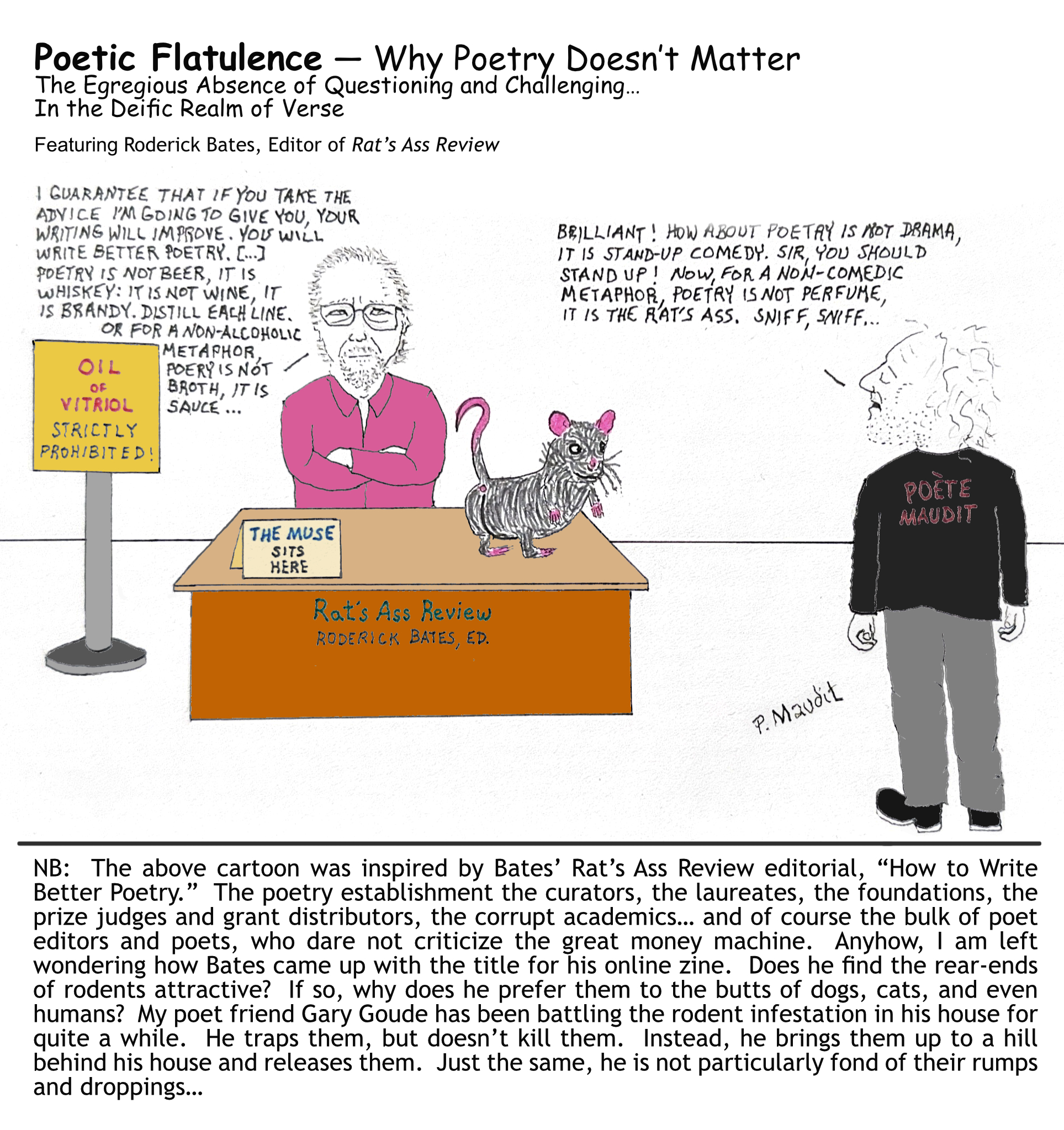
DISSECTING THE RAT’S ARSE
Roderick Bates, Editor of Rat’s Ass Review, states that “Rat’s Ass Review is a poetry journal whose editorial fancies are no more arbitrary than any other; they are simply more overtly so. I publish what I like.” Well, as editor of a different journal, I too publish what I like, but also what I sort of don’t like, especially criticism with my regard and the journal’s. In fact, I not only brook but encourage it! In any case, in a lengthy editorial essay, “How to Write Better Poetry”, Bates argues:
And, if you write, and are not delusional, you know that writing is painful […]. There isn’t much that can be done about the pain; that’s just the way it is.
Well, maybe someone ought to introduce the editor to extra-strength TylenoI! In the realm, his realm, of rodent rear-ends, I must be “delusional” because I’ve been writing for decades… and have yet to feel an iota of pain, physical or mental! How is that possible? Perhaps too many, if not most, writers would likely agree with Bates’ statement, which is not really an original one. The “pain” argument, like the “writing as hard work”one, seems to have become hackneyed, serving the writing industry—the literary established order—by helping to deify poets and writers as hard workers and perhaps even help increase their readership. Ah, but Bates is somehow a master of the art: “I guarantee that if you take the advice I’m going to give you, your writing will improve. You will write better poetry.” But how might the master define “better poetry”? The definition of a sophist is perhaps pertinent here: “A person skilled in elaborate and devious argumentation.” Bates’ elaboration is at antipodes to Thoreau’s dictum: “simplify, simplify.” And so, the editor writes:
Let’s begin with William Carlos Williams’ famous words: “No ideas but in things.” I am not going to tell you what they mean; that would not only violate their direction, but would limit your potential understanding of them. I will say these two things: the dictum has been said to define the direction of post-19th Century poetry, and it is an ideal thing to slip into your pocket or purse, and to hold in your hand in idle moments.
Now, who in their right mind would do that? Workshop poets? How not to dissect Williams’ statement? Indeed, why not both ideas and things? Or why not just ideas? And what might “things” not include in the realm of establishment poets and poetry, if not the satirizing of state poet laureates and the criticizing of the definers of poetry like Bates himself? Yet aren’t those “things”? Likely, for Bates, they are not. Note also that Bates seems to contradict the idyllic statement by arguing: “In a well-crafted poem every word is essential and ideas are tightly packed together.” Ideas! Ah, but Williams had stated “no ideas”! Moreover, as a poetry editor at antipodes to Bates, I quote rare poets who dared go against the machine like, for example, François Villon: “estoit-il lots temps de moi taire ? [should I have kept my mouth shut then?]” And Lord Byron: “I’ll publish, right or wrong:/ Fools are my theme, let satire be my song.” Bates seems to prefer the absence of clarity in the grain of self-glorification, something poets of the establishment, in general, obviously prefer.
Flowery language is not what makes a poem, density is what makes a poem. No matter how conversational the language, a good poem contains more than does prose.
Well, Bates ought to have added to his statement: density, as long as not densely critical of poet and poetry inflators. But poet and poet curator salaries depend on such inflation. “Poetry is not beer,” argues Bates, “it is whiskey: it is not wine, it is brandy. Distill each line. Or for a non-alcoholic metaphor, poetry is not broth, it is sauce.” Well, that actually got me laughing! And so, why not add to Bates’ metaphorical word-salad: poetry is not drama, it is comedy! The editor then argues that all poets should join a poetry workshop.
No, you are not too good to profit from a workshop. The one I am in includes a former state poet laureate, and she gets critiqued just like the rest of us. And no, you are not too delicate to withstand criticism. Or, if you are, you should stop writing and take up Sudoku or dusting.
Good point, but is it simply meant to be hot air? And why does Bates seem incapable like most poets to question and challenge what it really means to be anointed a “state poet” or poet with tenure? Do they discuss that in his workshop? Do they discuss Lord Byron ’s famous quote: “Bob Southey! You’re a poet, a poet laureate,/ […] / ‘A dainty dish to set before the King’” ? Today in America we have “Arthur Sze! You’re a poet, a poet laureate, / […] / ‘A dainty dish to set before the United States Congress’” (see “Poets Laureate of the United States … Government”/). And how sadly rare it is to read such criticisms in the realm of famous poets like Byron! And how difficult it is to find a critic amongst them. Over the years, I have hunted and posted the few examples found.
As for Bates’ “too delicate to withstand criticism” comment, almost all of the poets and poetry editors I’ve criticized over the past few decades were far “too delicate.” One poet editor, for example, responded to my criticism:
Dear Mr. Slone:
I spoke to my father [Todd Moore], the co-editor of our magazine [Outlaw Poetry], and have mutually agreed to retract the offer of accepting an essay by you for print in the next issue. We’re also requesting that future e-mail exchanges between you and myself, and my father and you be terminated as well. Thank you for your time. Best of luck with AD.
Sincerely,
Theron Moore
Co-editor St. Vitus’s Dance.
And another responded:
Silly Slone, I was trained in literary studies during a decade in graduate school with some of the foremost critics of the time. Your idea of criticism, from the shrillness of your rants, excludes any sense of illumination. Please do not contact me again.
Chris Busa, Ed., Provincetown Arts
Kudos to those two poets, for they actually countered the establishment norm of SILENCE IS GOLDEN. Yes, they deigned to respond, though not at all to any of the points made. My lengthy experience highlights the dark reality that the bulk of poets and poetry editors simply do not/will not respond to hardcore (real!) criticism with their regard. How about the editor of Rat’s Ass Review, who offers a free workshop to those he publishes:
And in the interest of promoting our own community, I should add that if you are among the poets chosen to publish in Rat’s Ass Review, you have the opportunity to join our on-line workshop. This workshop is free […]
Not quite sure how limiting the workshop to those who please the editor will result in critical feedback, which the editor argues to support: “If the first workshop you find is full of people who only get together to share cookies and praise, who never say anything critical, keep looking.” To that, he adds:
This next bit of advice might seem a bit selfish, but that’s OK; after all, you are doing all of this for yourself: find a workshop which is made up of people who are better writers than you are. You will tend to rise to the level of those around you.
Like Bates, it seems that perhaps most poets do not realize that “better” is a highly subjective term with regards to poetry. Instead, they open wide and swallow that which the curators present as somehow objective. Few poets will even wonder about the biases of the faceless judges of the Pulitzer, Pushcart, Griffin, etc., etc. The editor then suggests exercising.
Most of us, I suspect, have tried various exercises in hope of luring the muse somewhere near our writing desks.
Now, for some reason I have never done that. Why not? Well, it has always been outside instigations that provoked me to write. In other words, I have never sat down to try to write prior to such provocations. Experiences provoke me to write. In vain, I’ve suggested to some writers that they should write about their experiences. One of them, for example, has had amazing experiences living in a mental hospital and battling with her sister, but refuses to write about them. I’ve even suggested to another that she write something critical about the workshop she attends, but simply refuses to do so. Too many writers just write about anything but their actual experiences, likely because they have had none. Generally, for me, it has been personal experiences with corruption and the corrupt, though also the often vapid statements made by others, that provoke me to write (and cartoon!). Sadly, Bates does not even mention that as a possibility! The writing industry likely thrives on writers writing about anything but… the intrinsic intellectual corruption within its midst. It encourages the production of reams and reams of fluff. Bates encourages:
You probably don’t need to be told how easy it is to go a day, a week, longer, without writing. But you won’t ever be a writer if you don’t write. So get to it!
For me, I’d rather be ostracized into oblivion, than turn a blind eye regarding the inevitable intellectual corruption in the realm of the writing industry. My goal is certainly not that of Bates’ apparent goal to get published and renown. It is far more in line with Orwell’s “Why I Write”: When I sit down to write a book, I do not say to myself, ‘I am going to produce a work of art.’ I write it because there is some lie that I want to expose, some fact to which I want to draw attention, and my initial concern is to get a hearing.
Bates’ exercise suggestions really do underscore why poetry does NOT matter, contradicting former California Poet Laureate Dana Gioa’s essay, “Can Poetry Matter?” The latter incited me to write and cartoon critically. The following are two examples from Bates’ exercises.
Try writing a Clerihew, which is a four line poem rhyming AABB (that’s poetry shorthand for saying that the first two lines rhyme with each other, and that the last two lines also rhyme with each other, but do not rhyme with lines one and two). The first line is the name of some well-known person (or at least ends with that person’s name), the content of the poem is frivolous and pokes good-natured fun at the person, and you get extra credit if the meter is inconsistent and the rhymes are tortured.
Another exercise has become so popular among poets that it has its own name. If you stare long enough at a painting or a piece of sculpture, or perhaps a Grecian Urn, you may wind up writing an ekphrastic poem. To see several such poems that have appeared in Rat’s Ass Review, go here.
Now, how about an exercise that might be career risky, including read Bates’ essay and write a critical counter essay to it. Indeed, that might reduce a poet’s chances of getting published! Bates then suggests, “Show up at Readings, and Read.” Well, how about show up at readings and protest. Hell, I’ve done that on several occasions, including at the Concord Poetry Center and even at the Festival international de la poésie de Trois-Rivières in Québec, as an invited poet. Doing that can create wonderful grist for ones writing (and cartooning!). Bates then suggests: “Just Plain Read.”
Grab a contemporary poetry collection and get an overview of what a wide variety of successful poets are doing.
The question, which Bates and most other poets fail to address, is what precisely the subjective term, “successful,” really implies, if not climbing the ladder by turning a blind eye, conforming, and never openly criticizing—prerequisites for getting published and receiving invitations, awards, grants, tenure and laureate anointments. That is egregiously evident, yet few poets and writers will ever contemplate it. Yet another of Bates’ suggestions begs for dissection:
If you are a formal poet, don’t just read sonnets and quatrains and sestinas. Pick up a copy of The Outlaw Bible of American Poetry and scare the hell out of yourself. You may not suddenly begin to write eerily noir prose poems, but your next villanelle might have an edge or a bite that you may find new and exciting.
Well, the link doesn’t work, (now fixed — thanks, Dr. Slone) so I checked out theWikipedia write-up and Kirkus review. A number of the poets in the book became academics like Ginsberg and some are black racists like Baca and laureates like Harjo, who I dubbed “Poet Laureate Cog Supreme of the Poetry Machine.” So, obviously it is a farce to label many if not most of the poets in that book as “outlaws”! And of course I’d brought that to the attention of the editor of the Outlaw Poetry zine (see the response above). Why, one must wonder, do educated poets like Bates seem incapable of questioning and challenging that which is spoon fed to them?
Finally, contrary to Bates, I’d advise, more than anything else, that poets stand up against the machine, those hands that feed invitations, publications, grants, etc. Make poetry really matter! Don’t be so obsessed with, in Bates’ words, “getting your poems out there” and gaining renown! Rather work at a burger joint, than trying to make money off of writing by inevitably caving in to the ole see-no-evil, speak-no-evil, write-no-evil modus operandi… of “success.” Now, I wonder how Bates came up with the rather unpoetic title for his poetry zine. Does he somehow like the rear-ends of rodents? If so, why does he prefer them over the butts of dogs, lions, and/or humans? My poet friend Gary Goude has been battling the rodent infestation in his house for quite a while. He traps them, but doesn’t kill them. Instead, he brings them up to a hill behind his house and releases them. Just the same, he is not particularly fond of their rumps…
Post Scriptum:
To Roderick Bates, Editor of Rat’s Ass Review:
Please consider publishing in your review, my satirical essay, “Dissecting the Rat’s Arse.” Your readers might learn from it. Perhaps it would also help them modify, even just a little, their writing direction. Anyhow, thank you for the inspiration! Hopefully, you will respond… this time.
Post Post Scriptum:
Hi,
If you would send me a brief bio, I would like both your critique of RAR and the accompanying artwork for the Fall/Winter 2026 issue of Rat’s Ass Review, for publication on our website, perhaps in a print edition, and with luck, in an ebook edition. All other rights remain with you.
Is this OK with you?
Rick
The Contributors’ Bios:
J.R. Acero (he/him) is a 28-year-old South Jersey poet who writes with the unfiltered honesty of a private journal. His poetry revolves around societal decay, capitalistic violence, and our reverence for the natural world, while wrestling with masculinity, spirituality, mental health, love, loss, and everything in between.
Philippa Ancla is a 27 year old writer who grew up in care. She is currently developing a freelance career in the West Midlands, UK. A former success story of her Cornish school, university, and prestigious graduate employer, she left a high paying job to protect her health and her heart. When Philippa isn’t writing, she is mastering corsetry techniques, tailoring clothing, and running games of Blood on the Clocktower for her friends.
Jane Ayres was shortlisted for the 2021 Aesthetica Creative Writing Award. Her first collection edible was published by Beir Bua Press (July 2022) and micro-chapbook my lost womb still sings to me published by Porkbelly Press (October 2023) janeayreswriter.wordpress.com and Twitter:@workingwords50
Acacio Barros is a Brazilian-American physicist and philosopher. He writes about uncertainty, memory, language, family, and the ways people make sense of the world while misunderstanding themselves.
Ruth Bavetta’s poems have appeared in North American Review, Nimrod, Rattle, Slant, Atlanta Review, Tar River Poetry, and many other journals and anthologies. Her books are Fugitive Pigments, What’s Left Over, Embers on the Stairs, Selected Poems,, and Flour, Water, Salt. She likes the light on November afternoons, the music of Stravinsky, the smell of the ocean. She hates pretense, prejudice, and sauerkraut.
A German-born UK national, Rose Mary Boehm lives and works in Lima, Peru. Author of two novels, eight poetry collections and one chapbook, her work has been widely published mostly by US poetry journals. A new full-length poetry collection, ‘My Father’s Sky’, has just been published. Her collection LIFE STUFF has just received a five-star rating from ‘Reader’s Choice Book Awards’ and is a bronze winner. rose-mary-boehm-poet.com/
Isabelle Bohl began writing poetry upon retiring from teaching. She is a Pushcart Prize nominee whose poems have appeared in Quartet and Glassworks, among others. Her collaboration poetry book Our Various Selves (Cold River Press) was published in the fall 2025. She was born in France and recently moved from the Northern Adirondacks Mountains to the Twin Cities in Minnesota.
Satori Boularès is an author, poet, teacher, and community activist based in Chicago. Her work is heavily inspired by her immigrant “weird girl” upbringing in Upstate New York, generational trauma, and love in all its forms. Her debut collection of poetry, Monsters, Clowns, & The Holy Fool, was published in October 2025 by Raging Opossum Press. You can find Satori @sssatori on all platforms, or at the park becoming friends with all the bugs hiding in the cracks of the pavement.
Ingrid Bruck lives in Pennsylvania, a country landscape that inhabits her poetry. A retired public library director, she grows wildflowers, makes jam and writes haiku-ish short poems. She is a member of the Rat’s Ass Review workshop. Four poems were Pushcart nominees, two for Best of the Net. Some current work appears in Five Fleas Itchy Poetry, Verse-Virtual and Something Inside So Strong (IWWG Anthology). Poetry website: ingridbruck.com
Jeff Burt lives in Santa Cruz County, California, with his wife and a July abundance of plums. He has also contributed previously to Rat’s Ass Review, to Heartwood, Red Wolf Journal, and River Styx Magazine. He won the Cold Mountain Review 2017 Poetry Prize, the 2017 Heart Poetry Prize, and the Sheila-Na-Gig Winter 2020 Poetry Prize. He has a poetry book from Sheila-Na-Gig Editions, The Root Endures. More can be found at jeff-burt.com
Raymond Byrnes’s poems appear in scores of print and on-line journals such as Main Street Rag, Raw Art Review, and Shot Glass Journal. His work has been featured as Editor’s Choice in at least seven, including Typishly, 3rd Wednesday, and The Writer’s Almanac. He lives in Virginia.
Marietta Calvanico has lived a rich and varied life. She built a career in advertising/marketing, worked with her architect husband in client relations and doing agency work, raised a daughter who is a teacher, and played bass in late-night bars. Her poetry, fiction and memoir pieces have appeared on line and in print. Among her most recent publications is a double broadside entitled Requiem, published by Ink Publications.
Allison Camp is a Washington State native now living and working in North Carolina. A scientist by training, Allison has a deep affinity for biology and the fascinating details that abound in nature, so much so that she compulsively picks up acorns, insect wings, feathers, and other treasures. You can connect with her on Substack: allisoncamp.substack.com or Instagram: @electric.curiosity/
Sarah Carleton writes poetry, edits fiction, plays the banjo, and knits obsessively in Tampa, Florida. Her poems have appeared in numerous publications, including Nimrod, Valparaiso, Rattle, ONE ART, and As It Ought to Be. Sarah’s poems have received nominations for the Pushcart Prize and Best of the Net. Her first collection, Notes from the Girl Cave, was published in 2020 by Kelsay Books, and her second, Sprung Loose, will be available in September.
Wendy Taylor Carlisle lives and writes in the Arkansas Ozarks. She has published four full-length poetry collections and six chapbooks and is the winner of the 2020 Phillip H. McMath Poetry Prize. Find her in Susurrus, Swimm, Passager, One Art, Rat’s Ass Review and at her website wendytaylorcarlisle.com
Rebecca Clifford lives rurally near a watershed. Most recently, her work has appeared in Poetry Pause (League of Canadian Poets), Poem Alone (UK), Devour: Art & Lit Canada, Antae (Malta), Sola Poẽta, Merion West (US), and Stravaig (Scotland).
Axe Cornwell is a technocrat at heart. He lives in the woods in Quebec learning no French at all. You can find him on Instagram (@axe.cornwell) or Substack (@axecornwell).
Joe Cottonwood has repaired hundreds of houses to support his writing habit under the redwood trees in the Santa Cruz Mountains of California among wagging tails and dog-eared pages. His website is joecottonwood.com
Joe Couture is a writer living in rural Nova Scotia. If you want to connect with him, try here: @rjcouture.bsky.social.
John Delaney’s publications include Waypoints (2017), a collection of place poems, Twenty Questions (2019), a chapbook, Delicate Arch (2022), poems and photographs of national parks and monuments, Galápagos (2023), a collaborative chapbook of his son Andrew’s photographs and his poems, Nile (2024), poems and photographs about Egypt, Filing Order: Sonnets (2025), and CATechisms (2025), poems and photographs about his senior cat. He lives in Port Townsend, WA.
Dolo Diaz is a scientist / poet with roots in Spain, currently residing in California. Her work has appeared in ONE ART, The Summerset Review, Centaur, The Indianapolis Review, 2River View, among others. Website: dolodiaz.com.
Cover Artist Anita Dime is a noir lover, author of Five Mibs and a Martini, and artist, with recent work in Red Flag Poetry, Hum Magazine, and *82 Review. Follow on Facebook @AnitaDime or Instagram (@AnitaDime1982.
Clive Donovan has three poetry collections, The Taste of Glass [Cinnamon Press 2021], Wound Up With Love [Lapwing 2022] and Movement of People [Dempsey&Windle 2024] and is published in a wide variety of magazines including Acumen, Crannog, Interpreters House, Pennine Platform, Popshot, Rats Ass Review and Stand. He lives in Totnes, Devon, UK. He was a Pushcart and Forward Prize nominee for 2022’s best individual poems.
Precious Ejim is a poet from Boston, Massachusetts. She writes confessional poetry that explores womanhood, longing, and emotional vulnerability. Her work appears and is forthcoming in Misfit Magazine, The Lake Poetry, The Prairie Review, Ink Sweat and Tears, and Salt Bloom. She is influenced by poets such as Audre Lorde, Sylvia Plath, and Sharon Olds.
R. Gerry Fabian is a published writer and poet from Doylestown, PA. He has published seven books of poetry: Parallels, Coming Out Of The Atlantic, Electronic Forecasts, Wildflower Women, Pilfered Circadian Rhythm, Hidden Danger, including his poetry baseball book, Ball On The Mound.
Poet/photographer Alexis Rhone Fancher is published in Best American Poetry, Rattle, American Journal of Poetry, Spillway, Plume, Diode, and elsewhere. Her photos are published worldwide, including the covers of Pedestal Magazine, Witness, and The Mas Tequila Review. She’s authored thirteen poetry collections, most recently, Sinkhole, (MacQueens) and BRAZEN (NYQ). A multi Pushcart Prize and Best of the Net nominee, Alexis recently won Best MicroFictions, 2025. She calls the Mojave Desert home. www.alexisrhonefancher.com
Vern Fein wrote his first poem at 76 and since has been able to publish over 300 poems and short prose pieces in over 100 different sites. A few are: Gyroscope Review, Young Raven’s Review, Bindweed, *82 Review, River & South, Grey Sparrow Journal, and Rat’s Ass Review. His second poetry book—REFLECTION ON DOTS—was released late last year.
Wendy Freborg is a retired social worker and former editor whose poetry has been published by Rat’s Ass Review, Right Hand Pointing, The Orchards Poetry Journal, Misfit, and WestWard Quarterly. She is a frequent contributor to Scalar Comet and Little Old Lady Comedy. Her pleasures are her family, learning new things, and remembering old times. She writes poetry to find out what she is thinking but does not always like the result.
Meg Freer grew up in Montana and lives in Ontario, where she works in the arts. Her poetry, prose, and photos have appeared in many journals and in four chapbooks, and she has a full-length poetry collection forthcoming (DarkWinter Press). She is co-poetry editor for The Sunlight Press and holds two music degrees and a Graduate Certificate in Creative Writing. Find her published work on her Facebook page, or her Substack blog at https://megfreer.substack.com/.
Mac Gay is the author of 7 collections of Poetry. His poems have appeared in many lit mags including Atlanta Review, The American Journal of Poetry and Red Rock Review. He formerly taught at Georgia State University in Atlanta.
John Grey is an Australian poet, US resident, recently published in Midnight Mind, Willow Review and the Pennsylvania Literary Journal. Latest books, “Bittersweet”, “Subject Matters” and “Between Two Fires” are available through Amazon. Work upcoming in the MacGuffin, Touchstone and Willow Review.
Evie Groch, Ed.D., President of the Ina Coolbrith Circle, is the author of Half the Hurricanes. She has been published in My Robot & Me, My Father Taught me, Yearning to Breathe Free, Fresh Words, and other publications. She lives in California, but comes from the former Soviet Union where she lived in Kazakhstan and Uzbekistan. Her interests are languages, justice, and immigration. Her new book of poems, The Other Shoe, will be out soon.
Stephanie Hashagen lives in Verona, Wisconsin with her husband and four cats. She is a claims examiner for a disability insurance company. Her work has appeared or is forthcoming in The Muleskinner Journal, Maudlin House, Bramble, and Action, Spectacle.
Zachary Huneycutt is a poet and writer from Florida. He is the head fiction writer of Warp 10 Magazine and has work forthcoming in Jackdaw Press. You can read more of his poems on poetry.com at Zachary Huneycutt Poems or listen to his work live on Rattle Magazine’s weekly poetry podcast Rattlecast. Zachary writes across a wide variety of genres and themes, but if you don’t like his work, go kiss a rat’s ass.
Christine Jackson is retired from her day job, professor of literature and creative writing at a South Florida university. She continues to clock in on a life-long night shift writing poetry. Her work appears in an array of online journals, including The Ekphrastic Review, Verse-Virtual, South Florida Poetry Journal, New Verse News, The Disappointed Housewife, and Anti Heroin Chic.
Pankaj Khemka is a physician and poet. His work explores memory, the body, illness, and identity.
Barbara Krasner‘s most recent books include The Color of Time and Other Stories (Blaze/VOX, 2025), The Night Watch: Poems (Kelsay Books, 2025), and The Wanderers: Poems (Shanti Arts, 2026). She’s co-editor of Kelsey Review, the literary journal of Mercer County (NJ) Community College. She lives and teaches in New Jersey.
Born in Worcester, Massachusetts, Mark LaMonda is an artist and writer who currently lives in Santa Clarita California. His work has appeared or is forthcoming in Tabula Rasa, Bloomin’ Onion, Autumn Sky, San Pedro River Review, SoFloPoJo and Blue Unicorn.
After receiving degrees in Psychology from Wesleyan and Duquesne Universities in the previous century, and since completing Naropa University’s Creative Writing Program in Prague, CZ, Laurence Levey has published work in Versal, Ellipsis, the Barcelona Review, the Worcester Review, the New Guard, the Main Street Rag, Poemeleon, and elsewhere, and forthcoming in Arlington Literary Journal. He was a finalist for the 2023 Princemere Poetry Prize, and in the 2016 Breakwater Review Fiction Contest.
Nancy Smiler Levinson is author of a poetic memoir, Moments of Dawn; a chapbook, The Diagnosis Changes Everything; and some thirty books for young readers. She is a Pushcart Prize nominee for an anthologized essay, “Online Dating in the Golden Years.” Her work has appeared in Rat’s Ass Review, Dorothy Parker’s Ashes, Silly Goose Press, Jewish Literary Journal, Hamilton Stone Review, Silver Birch Press, and elsewhere.
Amanda London is a high school student from New York, USA, who spends most of her time dancing and journaling. She enjoys exploring themes of identity and personal growth through poetry.
C. I. Marshall’s debut chapbook, The Locksmith Journeys Into The Afterlife won the 2022 Frosted Fire First Pamphlet Award. Credits include: Steam Ticket, Birmingham Poetry Review and others. Marshall was a 2024 and 2025 Tucson Festival of Books Literary Awards Finalist. Marshalls’ work was included in the 2025 National Baseball Poetry Festival, the 2025 Write Out Loud, “Echoes” Poetry Anthology Competition, judged by Neil Astley, Editor of Bloodaxe Books. One of Marshall’s poems was shortlisted for the Bridport Prize, UK and another poem was commended for the 2025 Stanza Competition for The Poetry Society, UK. For more about C.I.’s writing visit: consuelom.wordpress.com
Anne McCulloch lives in Edinburgh, Scotland. She was long listed in the National Poetry Competition in 2024 and has published in Poetry Scotland.
Aaron McGuffin is a poet and physician who lives and writes in the mountains of Appalachia. He is currently completing an MFA in poetry at West Virginia Wesleyan University. His work explores the liminal space of whimsy and gravity in family, memory, and medicine. His poems have appeared in Archives of Pediatrics & Adolescent Medicine, Intima, Pharos, Literary Hatchet, As the Crow Flies, and \ ContiguousLyt, with work forthcoming in Appalachian Journal and Red Ogre Journal.
Ed McManis is an erstwhile Head of School. He has been published extensively, won more contests than Susan Lucci and been short-listed more times than Barney Rubble. He holds the outdoor free throw record @ Camp Santa Maria: 67 in a row.
Sally Mills is a poet and attorney from Downeast Maine. She studied the Russian Silver Age poets and holds an MPhil on Anna Akhmatova. Her work has appeared or is forthcoming in The New Verse News, The Main Street Rag, Sheila-Na-Gig, The Esthetic Apostle, and Mobius: The Journal of Social Change. When not writing poetry or practicing law, Sally performs with The Damn, Girls! Hancock County, Maine’s premiere country-western girl band.
Eric Montgomery is a writer and poet living in Washington State. Following a career in information technology, he turned his attention to writing and creative work. He is the creator of the #AmpersandAfterDark writing challenge on Bluesky. His published work includes two poetry collections, a collection of poetry and short stories, and a children’s storybook. He can be found on Bluesky at @madp03t.bsky.social.
Magdalena Morris is a Polish-British writer with an MA in Contemporary Literature and Culture from Birkbeck, University of London. She loves to read dark fiction and writes her own strange stories, one of which was published in Novellum Magazine. Magdalena lives in London with her husband, son and two cats. She works in publishing, is currently working on her first novel and can be found on Instagram @magdalestrange.
Karen Moulton is the author of three chapbooks: One Year Ago Today and Other Poems of Revelation, NOW, and The Unpartnered Wife. Her work has appeared in Rattle, SLANT: A Journal of Poetry, The Ekphrastic Review, and is upcoming in The Reprise and The Marbled Sigh. A retired international teacher, she lives in Flippin, Arkansas with her husband, Ken and their dog, Darwin.
Jim Murdoch is a prolific Scottish poet. In 2025 alone, he published 140 poems and is on target to exceed that this year. Most often, as is the way, his work winds up in webzines that fold after two or three issues but occasionally he’s managed to catch the eye of an editor in more established journals like Acumen and Stand.
Joey Nicoletti (he/him/his) is the author of 11 poetry collections, including Cannoli Gangster, which was selected as a finalist for the Steel Toe Books Award, Boombox Serenade, and Sisyphean Mask, which is forthcoming in 2027. Joey’s debut nonfiction book, Extinction Wednesday, was published in 2024, and he is the Reviews Editor of Voices in Italian Americana (VIA). Connect with him on Insta @joeynicoletti and Bluesky joeynicoletti.bsky.social
Marie Pauwels (31) is a freelance journalist from Belgium living in Athens, Greece, where she considers herself retired. It is incredibly rare to see Marie without a freddo espresso sketo, a cigarette, or both in hands. Marie despises ChatGPT and loves trap music.
Robert Perchan born in Cleveland Ohio. Grew up there. After BA MA PhD taught college courses aboard USN ships deployed Mediterranean and Western Pacific. Debarked Busan Korea. Found work. Best books crazy metafiction Perchan’s Chorea: Eros and Exile followed by poetry book Fluid in Darkness, Frozen in Light and novel Tropic of Scorpio etc. Married to translator Mi-kyung Lee.
Darrell Petska is a retired university engineering editor and three-time Pushcart Prize nominee. His poetry appears in 3rd Wednesday Magazine, Orchards Poetry Journal, Soul Poetry, Prose & Arts Magazine, and widely elsewhere online and in print (conservancies.wordpress.com). Father of five and grandfather of seven, he lives near Madison, Wisconsin, with his wife of more than 50 years.
Kenneth Pobo (he/him) has a new book out called Raylene and Skip (Wolfson Press). Also recent is Lavender Stones (Rockwood Press). He’s retired and spends a lot of time in the garden.
Ken Poyner has eleven available collections of poetry, flash fiction and micro-fiction, the latest “The Lechery of Fish Tuners”, drabbles. He has suffered ten Pushcart nominations without a win, and has taught on an NEA Poets in the Schools grant. He spent 33 years herding computers. He is married to a world class female powerlifter, who is still setting raw world records. kpoyner.com
Ed Robson spent 40 years practicing psychology in North Carolina before retiring to pursue his love of writing. He earned an MFA, had a heart attack, found his groove in Guatemala, and finally gave up on slowing down. His first poetry collection, Carping Every Diem, is available at brambleonline.com.
Marybeth Rua-Larsen lives on the south coast of Massachusetts, and her poems have appeared in Magma, Crannóg, Eclectica Magazine, Snakeskin, Puslebeat and Arderyth House, among others. She was a Writer in Residence at historic Linden Place in Bristol, RI. Her chapbook Nothing In-Between is available from Barefoot Muse Press.
John Rutherford is a poet and writer living in Beaumont, TX with his wife Caitlin and three badly behaved cats. He has worked in the Department of English and Modern Languages at Lamar University since 2018. In 2026, he completed an MFA in Creative Writing at the University of St. Thomas (Houston).
Jeff Ryan is a writer living in New York City. His poetry has been featured in The Lake, One Art, WestWard Quarterly, Beach Chair Press, Nuthouse, and the cherita.
Bill Schulz lives in Maine, not far from the farm where his ancestors settled in the late 1700s. His book, Dog or Wolf, was published in July 2022. His latest book of poetry, Another Psalm, was published in December 2024. His work has appeared in The Seneca Review, Nine Mile Magazine, Nixes Mate, The Aurorean, and many other publications. He is the founder and former editor of Hole In The Head Review.
Claire Scott is an award-winning poet who has received multiple Pushcart Prize nominations. Her work has appeared in the Atlanta Review, Bellevue Literary Review, New Ohio Review and Healing Muse among others. Claire is the author of Waiting to be Called and Until I Couldn’t. She is the co-author of Unfolding in Light: A Sisters’ Journey in Photography and Poetry.
Christopher Scribner is a retired Clinical Psychologist, a former collegiate Ultimate Frisbee player, and Professor Emeritus of Psychology at Lindenwood University, where he also completed an MFA in Creative Writing and earned a Songwriting Showcase Award for his “Covid-19 Rap.” His poetry, satire, and humor have appeared in a variety of journals. He’s a member of the Babler Poetry Society in St. Louis.
Susan Shea is a retired school psychologist, who was born in Brooklyn, New York, and now lives in a forest in Pennsylvania. In the last three years, she has become a full-time poet. Since then, her poems are in, or are forthcoming in Peatsmoke, The MacGuffin, Sheila-Na-Gig, EcoTheo Review, Burningword, ONE ART, Chiron Review, and others. She is a Pushcart Prize and the Best of the Net nominee.
Jacqueline Shea Murphy holds an MA in fiction (Johns Hopkins) and a Ph.D. in English (UC Berkeley), where she was winner of the Eisner Prize for Highest Achievement in the Creative Arts. She is Professor of Dance at the University of California, Riverside and author of books about Native American dance history and the dance making of Indigenous choreographers. In 2024 she was a Fulbright fellow at the Seamus Heaney Writing Centre, Queens University, Belfast.
Carol Shillibeer‘s poems and stories have been published in many print and online publications, and received nominations for both Pushcart and Best of Net. She has books out with Dancing Girl Press under the name ‘Pearl Button’ and her first book ‘footnote to Silence’ came out with gnOme under the name Ars Cogitanda. One of her most recent manuscripts ‘language be like’ won the 2025 Alfred G. Bailey Prize for poetry.
Sushanth Shyamsundar is a queer, asexual Indian poet, writer, and spoken-word performer based in Chennai. His work explores identity, grief, friendship, family, neurodivergence, memory, and the absurdity hidden inside ordinary life. He performs as Rakshasan and is the founder of Rakshasan Media.
George HS Singer is published in several national journals including Prairie Schooner, The Massachusetts Review, and Tar River Poetry. His book, Ergon, was published by Wordtech Press. He was a Zen Buddhist monk for several years in his 20s. He later served as professor of special education at UC Santa Barbara. Today, he lives with his life mate, two dogs who safeguard them from squirrels at their home where he writes and meditates. He write about how he tries to let the ways his senses, heart, and brain at times let him live more deeply as life is more tenuous and miraculous with the gradual onset of age. He is 77 years old and just getting started.
Matthew Sisson’s poetry has appeared in journals ranging from the Harvard Review Online to JAMA (The Journal of the American Medical Association). He has been nominated for a Pushcart Prize, and has read his work on NPR’s On Point. His book, Please, Call Me Moby, was published by The Pecan Grove Press, of St. Mary’s University, San Antonio, Texas.
G. Tod Slone Founding editor of The American Dissident, a journal of literature, democracy, and dissidence. Doctoral degree from the Université de Nantes (France). Taught at a number of colleges, including two HBCUs. Never got tenure; always openly criticized my intellectually corrupt academic bosses. Photographer of northern beauty (Labrador, Newfoundland, Québec).
Alec Solomita is a writer working in Massachusetts. His fiction and poetry have appeared in many journals and anthologies, including the Southwest Review, The Mississippi Review, The Lake, The New Criterion, The Rye Whiskey Review, The Galway Review, Red Dirt Forum, and ONE ART. His chapbook “Do Not Forsake Me,” was published in 2017. His full-length poetry book, “Hard To Be a Hero,” was released in the spring of 2021. He’s just finished his third collection, “Glass Flowers.”
Greg Stewart is a Canadian poet based in British Columbia. His work has appeared in ONE ART. He writes and performs regularly, including at Poetry Floodlight in New Westminster, and is on Substack at @gregstewart128683
Mercury Sunderland (he/him) is an autistic gay trans man from Seattle. He’s been published by University of Amsterdam’s Writer’s Block, University of British Columbia’s Decomp, UC Davis’ Open Ceilings, UC Riverside’s Santa Ana River Review, and UC Santa Barbara’s Spectrum.
Maria Tass holds a degree in Psychology and has work in 50-Word Stories and Gray & Granite. Based in Toronto, she revels in the city’s secondhand shops and hidden laneways where the strange and beautiful converge. You can find Maria at instagram.com/mariatassop
Jenni Thorne is a writer from the Black Country, UK and and winner of the 2025 New2thescene poetry prize. As well as being published in various poetry collections and on-line journals including Starbeck Orion, Ink, Sweat and Tears, April Showers, Dark Poets, Broken Spine and Sixty Odd Poets, she shares her poetical ramblings on Bluesky @jenthorne.bsky.social.
Susan Thornton lives and works in Binghamton, New York, where she has been a technical writer, an academic editor, and for her sins, an eighth grade French teacher. A collection of novellas is forthcoming in 2027 from High Frequency Press. Recent work has appeared in The Berlin Review and the Brussels Review.
Ashten Vassar-Cain is an emerging poet and an archivist. His work has appeared in The Center for Liberatory Poetry and Practice, The Disability and Access Collective and the UConn Free Press, with publication forthcoming in Transchool vol. 3 (Co-Conspirator Press).
Kate Venables’ poetry has appeared in magazines such as Ink, Sweat & Tears, Envoi, and The Frogmore Papers, and in the Hippocrates and Live Canon anthologies. She is a retired doctor and lives in Oxfordshire.
Chris Vola is the author of 11 books, including the collections You’re Going to Hate the New Apartment (Alien Buddha) and E is for Ether (Leaf Garden Press). His poems appear in places like Maudlin House, Main Street Rag, scaffold, Horror Sleaze Trash, New Pop Lit, and Neologism Poetry Journal. He lives in New York.
Michael Walker is a writer living in Newark, Ohio. He is the author of two books: 7-22 and The Vampire Henry. He has also seen his stories and poems published in various magazines including Sky Island Journal, PIF, and The Adelaide Literary Review.
Kendra Whitfield is a retired English teacher living on the edge of Canada’s boreal forest. She is the 2026 winner of the Athabasca University Ekphrastic Poetry Prize, a finalist for the 2026 Poetry Lighthouse Prize and a Pushcart nominee. When not writing, she can be found basking in sunbeams on her deck or swimming laps at the local pool.
Chloé Rose Whitmore is a writer and poet from Nottingham. Her work has been published in Mslexia, New Nottingham Journal and Dear Damsels, among others, and she has been longlisted for the Manchester Poetry Prize and the Queen Mary Wasafiri New Writing Prize. She has an MA in Creative Writing from the University of Nottingham.
M. Brooke Wiese’s work has appeared in The Orchards, Pulsebeat, Burningword, Persimmon Tree, New Lyre, Impossible Archetype, Poets for Science, and elsewhere. Her second chapbook was published in 2025 (Finishing Line Press), and her third is now out (Bottlecap Press). Billy Collins has taught her sonnets. Brooke lives with her wife and sons in New York City and currently teaches at a special education school to high school students of all ages and abilities. www.mbrookewiese.net
Heather Wishik is a poet and visual artist living in Woodstock, Vermont. She studied poetry with Ellen Bryant Voigt and Heather McHugh at Goddard College, and with many other teachers since. In addition to poems, she creates combinations of poetry and visual images she calls “poellages.” Wishik has shown her poellages in Vermont and New Hampshire at the Mezzanine Gallery, Norman Williams Public Library; the Karen Kitzmiller Room, Kellogg Hubbard Library; Dartmouth Health Cancer Center; and at the Kolaj Institute Gallery in New Orleans. She has poems in the anthologies Gay and Lesbian Poetry in Our Time (Morse and Larkin, Eds.) and New Lesbian Writing (Cruikshank, Ed.); and in various literary magazines including, most recently, Rat’s Ass Review, Spring-Summer 2026.
Robin Wright lives in Southern Indiana. Her work has appeared in Amethyst Review, The Literary Nes, Rat’s Ass Review, As It Ought To Be, The Beatnik Cowboy, Lothlorien Poetry Journal, The New Verse News, One Art, The Loch Raven Review, Panoply, and others. She is a Pushcart Prize nominee and a Best New Poets nominee. Her first chapbook, Ready or Not, was published by Finishing Line Press in 2020.
Wally Wright’s journalism background informs his memoir-driven poems about queer life, Catholic guilt, travel and the poor decisions that make the best stories. His work has appeared in Down in the Dirt, Queerlings and Scrawl Place. He lives in Chicago and runs The Not So Innocents Abroad with his husband, Duke.
Ann Youmans lives in a Midwestern university town but isn’t a professor or farmer (she’s an editor and election judge). Her interest in herbaceous borders is partly from Agatha Christie, partly from vivacious grandmothers whom she had the joy to know as an adult. You can find her poetry in the chapbook Downstream and a wide number of journals.