Until the Spring-Summer 2025 issue, Rat’s Ass Review has been a review in name only. It has published hundreds of poems, many of them quite good, but it has never attempted to offer an assessment of a body of work.
Now approaching its fifteenth birthday, RAR is belatedly celebrating a sort of literary bar mitzvah as it announces: “Today I am a Review.”
How fitting that the voice is that of founding editor David M. Harris, who returns to consider the latest work of poet Annette Sisson.
David M. Harris
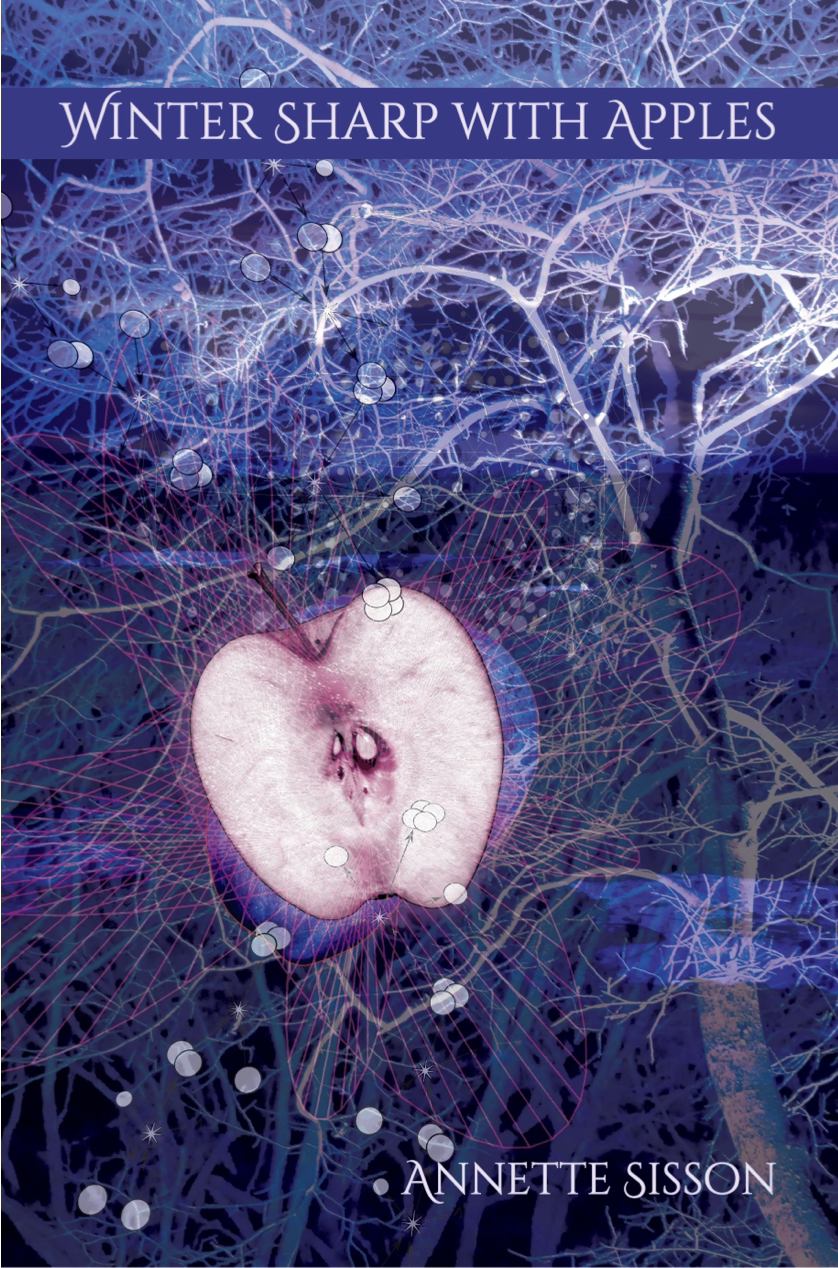
David M. Harris reviews poet Annette Sisson’s new work: Winter Sharp With Apples
It has been, for a while, a commonplace that poetry collections should have themes, as though respectable poets devote themselves to one issue at a time, and nothing else. And there are plenty of quite good poets who do just that, writing fifty or a hundred poems in a row, all exploring a single question or story.
But this is a recent development, and simply does not apply to poets who, like Annette Sisson, have some themes to which they return, but by which they are not obsessed. Sisson’s latest book, Winter Sharp With Apples (from Terrapin Books), turns often to images and ideas about nature and our place in it, but it also shows us a wide-ranging mind at work.
One of the important factors that holds the collection together is Sisson’s radical honesty. Her frank voice and open relationship with her readers hold our attention and allow us – even urge us – to step beyond the most easily accessible level of her poetry and dig for more, knowing that the digging will be profitable.
Of course, honesty has been, for the last century or so, one of the factors we expect from poetry with ambition to be more than self-expression. Self-expression is fine for beginning poets, but it is only a beginning; good poets tie what they have learned about themselves to what we can learn from them about ourselves. Honesty includes the self-knowledge that your relationship with your mother is of no interest to us unless it illuminates our relationships with our mothers.
And that is where Sisson shines. A poem such as “Clutch,” for example, looks at her relationship with her mother without complaining (empathy, after all, is part of radical honesty) and finally acknowledging that holding on is a necessary prequel to letting go. Both parents of adult children and the children themselves can feel the truth of this. Sisson consistently draws us into experiences from her life and expands them to encompass the lives of her readers as well.
Nearly all the poems in Winter Sharp With Apples do come from her own experiences. Sisson invites us into her life, in part as an example of what can be done with memory, observation, and imaginative consideration. Observation and imagination lead us to vivid and meaningful imagery, with lines like “We lug our stunted childhoods//like rusted spikes” (from “Muscle Memory’) or “trophies – coins//to feed the machine of his parents’ need” (from “Galloping in Darkness”) that provide worlds of context in a few words. We see, or we remember by analogy, much of how these families work, and we can share in the author’s finding ways out of those dilemmas.
Perhaps Sisson’s life has not been extraordinary, the making of a hit film. She has seen some things that most of us have not, but that is not in itself exceptional. Sherlock Holmes says to Dr. Watson (in “A Scandal in Bohemia”) “You see but you do not observe.” Sisson observes. She pays attention and, like Holmes, extracts meaning where others might not notice it. Add to that her considerable gift for conveying that meaning, and we have a book that is itself a considerable gift for her readers.
Editor’s Note: You can find a sample of Ms. Sisson’s work, the poem What the Scan Doesn’t Show, here in our Spring-Summer 2022 Issue./RGB
Richard Collins

ON HAVING NO HEAD: JOHNNY CORDOVA’S THE BROKEN BUDDHA ( ROADSIDE PRESS, 2026 ).
One of the best books on Buddhism I ever read is Douglas Harding’s On Having No Head: Zen and the Rediscovery of the Obvious. I was reminded of this when reading Johnny Cordova’s forthcoming first book of poetry, The Broken Buddha (Roadside Press, 2026). This makes sense, considering that the literary forebears Cordova hangs out with are such as Li Po, Ryokan, Ikkyu, Jim Morrison, Indian fakirs, and sundry beggar poets. What they all have in common is that their spiritual journeys are embedded in the sensual floating world, sometimes ecstatic, sometimes heartbreaking, always true.
There aren’t many writers who can make a collection of poetry read like a lyric novella, but this is the effect of the book’s three sections, which take us from erotic adventures in Thailand in “All Night Rain,” through his spiritual tours in India in “Sketches of India,” then back to the roots of an American upbringing (and downfalls) to see where it all began and may end in the final section called “Ashes.”
The Broken Buddha of the title poem serves as the controlling metaphor and synopsis of the poet’s story, how he identifies with an ancient Burmese statue that he finds in a public bazaar. It had been broken, he speculates, by some careless monk, only to be cast off as trash and then to languish in the marketplace for years until:
I bought him because I too missed a step
and went crashing down some stairs
my love in my arms
and could not be put back
together.
Thus the ensuing exploration of getting entangled in the “red thread of passion between one’s legs” in Thailand, the search for clarity and reparation in India, and a narrative resolution at home as he finds forgiveness in the ashes of the bridges he has burnt in his life, and above all in the ashes of his young daughter whose death was a breakage that could only be repaired by repairing his life.
If we are honest, though, we are all broken, just as we are all Buddha. One loses one’s head, unable to see ourselves except from the partial perspective of a disembodied self-awareness. But this perspective can be made whole again, if only we embrace our whole selves, body and mind. We can put our heads back on. Losing it can be painful, but as Harding explains, also necessary for any awakening that comes with spanking the ego. The repair serves as a reminder of what egregious errors we humans are capable of, but also how they teach us lessons we might otherwise have missed out on. I should point out that Cordova never comes off as a didact or moralist, that is my own projection and interpretation. Always candid, never crude, he continues to embrace the messy proposition of being human, with all its brokenness and put-togetherness.
Kintsugi is the Japanese art of repairing broken things with gold and lacquer to demonstrate not only the ephemeral nature of our material nature, but also how broken things (like hearts and buddhas) can be even more beautiful when repaired with art, can in fact have a life that endures well after their first unbroken one.
Full disclosure: I once met Johnny Cordova briefly at the Arizona ashram where he practices a daily meditation and tends the resting place of the ashes of his daughter. And where he lives with his wife, the poet Dominique Ahkong. Together they co-edit Shō Poetry Journal, resurrected in 2023 after a twenty-year gap, along with their new Beggar Poet Series. I can tell you this: you can hardly see “the crooked / cracked line” around his neck, and it is golden.
Peter Mladinic

More, a review of Captain Beefheart Never Licked My Decals Off, Baby, by John Yamrus. Anxiety Press. 2025. $16. paper.
John Yamrus is in the packed house of a big theater. The Magic Band has finished their concert, and the audience wants them to come back. Captain Beefheart comes back on stage alone, stands and whistles the entire “More,” a pop song antithetical to the avant-garde sounds of the band. No words, no music except for the Captain’s whistling. Then he walks off. Just one example of the outrageousness evoked in this John Yamrus memoir introduced by Sarah Hajkowski, who gets it. With not-a-word-wasted Hajkowski nails Yamrus, and his memoir. “The whiff of lofty principles with no substance will always catch his nose with distrust, but the ass-end-of-a-fish authenticity of real hold on tight weirdos has Yamrus’ eternal respect.” More about the fish, a dead fish, later in this review. In centering his memoir around The Magic Band’s album Trout Mask Replica, Yamrus “reels in” ideas on art, music, and literature that place the album in a cultural milieu that is at the center of his artistic-spiritual life. How he says what he says is key to an appreciation of a writer who has been rightly called “the master of minimalism.” Like Sarah Hajkowski, John Yamrus comes right to the point.
Robert Frost, when asked to define poetry, said it’s a thing poets write. Art is a thing artists do. In putting the Beefheart album in an artistic context, John Yamrus notes how The Magic Band’s thrift store, ragtag attire sets their album art apart from album covers of other musicians of the psychedelic era of the late 60s and early 70s, whose attire reflected a sort of ruffled shirt Elizabethan look. Yamrus mentions The Rolling Stones; other examples of that ruffled attire are Paul Revere and the Raiders, and The Yardbirds. The ragtag Magic Band not only sounded different but also looked different, in thrift store threads that, on album covers, got a reaction. Yamrus likens The Magic Band’s attire and their music to Marcel Duchamp’s Nude Descending a Staircase, the painting’s “fractured bits and pieces and angles and edges and how they all came together to make something whole and different and real.” On The Magic Band’s album Trout Mask Replica, “cut 13, DALI’S CAR” is “a direct reference to the king of surrealists, Salvador Dali.” Also the surreal artist Andy Warhol is referenced as Yamrus links what listeners hear (music) to what views see (art).
A poem “old records” in the middle of his memoir, ends with the mention of Lee Andrews and The Hearts, a vocal group from the 50s; some call their music doo wop, others say rhythm & blues. To Yamrus, labels are not important; what’s important is the distinctive sound that leads Yamrus in his poem to call the group “the one and only Lee Andrews and The Hearts.” He explores The Magic Band’s roots in the blues and the similarity of Don van Vliet, Captain Beefheart’s voice, his sound, to the sound of the famous blues musician Howlin Wolf. Yamrus talks about Bob Dylan’s transition from acoustic to electric music, and about another innovator, Frank Zappa, whose band van Vliet played in and who recorded The Magic Band’s Trout Mask Replica. John Coltrane’s A Love Supreme is Trout Mask’s jazz counterpart. Two very different albums, Beefheart and Coltrane are similar to Yamrus in that”It seems to me that every artist…every real artist…pushes things to the limit and then pushes again, harder.” Coltrane’s a good example.
Allen Ginsberg’s poem “Howl,” also pushed things to the limit, as did the innovative poems of Lawrence Ferlinghetti, and the prose of Jack Kerouac. Similarly, in the nineteenth century Lewis Carroll’s Alice in Wonderland was something new, surreal, and real.
Yamrus references the twentieth century science fiction of Clifford Simak, and the fiction and nonfiction of Norman Mailer, differentiating the hard edged prose of Mailer’s The Fight, an account of the famous boxing match in Zaire between Muhammad Ali and George Foreman, to Mailer’s mannered first novel The Naked and the Dead. Readers can only wonder if the author of The Armies of the Night appreciated Trout Mask Replica. Just as Yamrus’s insights lead him to links between Trout Mask and art, they also bring him to things that the best of Mailer have in common with that album, namely attitude and reaction. Yamrus recalls Miles Davis in a get-right-down-to-it attitude. “Anybody can play. The note is only 20 percent. The attitude of the motherfucker who plays it is the other 80 percent.”
People react to art. John Yamrus does. The album cover of Trout Mask Replica, Captain Beefheart holding up a dead fish to his face, got John’s attention. As did the Hot Tuna concert where, for a moment, the rest of the band appeared to be mocking their fiddler Papa John Creach as he was playing a solo on “Keep Your Lamps Trimmed and Burning” that his audience, Yamrus among them, was really “getting into.” At another concert, The Magic Band at the Comerford Theater, the reaction is different. Yamrus evokes in concise, exacting phases the dim depth of the Comerford, placing his readers right there, way up in the balcony, as Captain Beefheart, called back for an encore, whistles his solo rendition of “More.” That got their attention. Yamrus tells everything his readers need to know, right down “to the warm red cloth seats we were in” and not a word is wasted. In her introduction Sarah Hajkowski says:
”Composed by Don “Captain Beefheart” Van Vliet and his Magic Band in 1969, the controversial studio album Trout Mask Replica is the center point from which the entire narrative branches out.”
Yamrus illuminates; he discovers connections between art and music, art and literature, and music and literature, that he likely hadn’t thought of before beginning his memoir. In his need to know, he creates those connections, and does it with attitude.
And a Coda
John Yamrus
TALK ABOUT SYNCHRONICITY
Talk about synchronicity . . . and blind, stinkin’ luck! Every now and then I seem to do something right (no matter what my wife says). Here’s the story: I recently published a book called CAPTAIN BEEFHEART NEVER LICKED MY DECALS OFF, BABY. It’s a really short book (trust me), but I had high ambitions and tried to touch a lot of bases with it. On the surface it’s a book about a 1968 rock and roll album that very few people have heard of and even fewer (trust me, again!) understand or appreciate. The album is called Trout Mask Replica and the group is Captain Beefheart and The Magic Band. The title of my book kinda references an album they released right after Trout Mask, called Lick My Decals Off, Baby and people have told me (as if I didn’t already know) that giving my book the title that I did doesn’t make any sense, but you gotta look at it from my perspective and think about how bad it would have been if I called the book CAPTAIN BEEFHEART’S TROUT MASK FUNHOUSE or something like that. It wouldn’t have made any sense, and you wouldn’t be reading this article right now because I wouldn’t have cared a rip to write it.
Anyway, for some reason, the book struck a chord with readers . . . people who regularly buy my books and people who are still able to look back at the ‘60s and smile. And that’s cool.
Like I was saying, the book tries to touch a lot of bases in a very few pages – but hey, I AM known mostly as a minimalist. I’ve even taken it so far as to publish a poem that’s just one word long. I can talk about that poem and the dust it stirred up in a ton of places and all the “literary” arguments it caused, but right now I’ll let that conversation sit for another time and place . . . right now I’m talking about my Beefheart book, and the things in the book that have absolutely nothing at all to do with The Captain or his music or that one, strange and wonderful album. Things like the genetic duplication of dinosaurs and the pros and cons of running away from home. And why are there very few corner candy stores around anymore? What’s with that? And whatever happened to the nice old man and old lady who ran the one you used to go to?
If you can dig all that, maybe you’ll dig the book.
But, I was talking about synchronicity . . . at least that was the first line of this little article here. Synchronicity. It’s such a nice word. It feels good when you say it. It makes you sound like you know what you’re talking about. It makes you sound smart.
Most times, I don’t. And most times I’m not, so I looked it up . . .synchronicity. The first definition I found described it as “The simultaneous occurrence of events which appear significantly related, but have no discernable causal connection.”
That’ll work. No discernable causal connection.
Now, put that thought in your back pocket and let me get back to talking about the book. Like I said, it was doing well (and that’s a relative term, because I’m very much a small press kind of guy with small press kind of sales, so you know what that means) and I was looking for ways and places to help get the word out . . . for me and my publisher and even those few readers who have stuck with me thru everything for more years than I care to count. Actually, I DO count . . . I can tell you how many books I’ve published (43) and how many poems I’ve published (exactly 3,587 as of yesterday morning) and how many years I’ve been doing all this (55. My first book came out in 1970, which actually makes me older than dirt or snot, whichever came first).
So, here I am, looking for ways to get the word out on my little book about a band nobody’s heard about and an album very few love. And I start looking around on my computer. I start looking up websites and Facebook groups about Captain Beefheart and The Magic Band and I was sort of surprised to see just how many Beefheart groups and sites there are. Tons of them. Some with just a few members . . . maybe a couple dozen or a hundred or so . . . and some with thousands and thousands. I have to say I was surprised. And the marketer in me . . . the salesman in me . . . starts to thinking . . . what if I joined some of these groups and posted some things about my book? Wouldn’t that be a great way to get the word out and get a couple or two or three new readers?
So, I did it. First, I joined some groups and then started posting some of those goofy little ads about my books that have served me so well in the past. I geared it toward the Beefheart book, of course . . . and when people responded with a comment or a “like,” I took it from there. And it was fun. It still is. And then it got to a point where I was even in some “chats” or whatever the heck they’re called (remember, I’m 74 and not the sharpest knife in the drawer when it comes to computers and things) and I start talking back and forth with someone named Jeff. He seemed like a nice enough and smart enough guy, so I looked up his name (I’m at least smart enough to be able to do that) and the guy’s name is Jeff Cotton. A nice name. Ordinary enough. Jeff.
I can’t say we talked for very long . . . I mean, we didn’t swap photos of our dogs or early girlfriends or anything like that, but, we talked and he really seemed to know what he was talking about when it came to Trout Mask. And then (I’ll keep this short and maybe even leave out some stuff that doesn’t need to be brought up here and now) . . . and then he sends me this old publicity picture of himself from way back in 1968 . . . back when he was more popularly known as Antennae Jimmy Semens. It turns out that Jeff Cotton . . . the same Jeff Cotton I had been talking with back and forth . . . the guy who seemed to know an awful lot about the Trout Mask album was and still is Jeff Cotton, AKA Antennae Jimmy Semens! He played freakin’ guitar on one of my favorite albums ever. How cool is that???
Talk about synchronicity. Talk about cool. Talk about this old rock and roll lover having a pinch me moment! I couldn’t wait to tell my wife! I couldn’t wait to tell everybody! My stupid little book got me talking with THE Antennae Jimmy Semens.
I told Kathy, and I don’t think she was impressed. Much. I mean, she smiled, but it was the kind of smile you give your old uncle Dutch when you see he finally figured out how to put his toupee on straight. But, we’ve been married 50 years (as of a couple weeks ago) . . . long enough to know that she thought I did good.
So, here I am, right now, sitting here at my desk in the basement. I got a new book out . . . I got to talk (however briefly) with the guy who played guitar on Trout Mask Replica, one of the best and coolest albums ever . . and I have a wife who loves me enough to let me know when I finally went and got my wig on straight.
G. Tod Slone
DISSECTING THE RAT’S ARSE
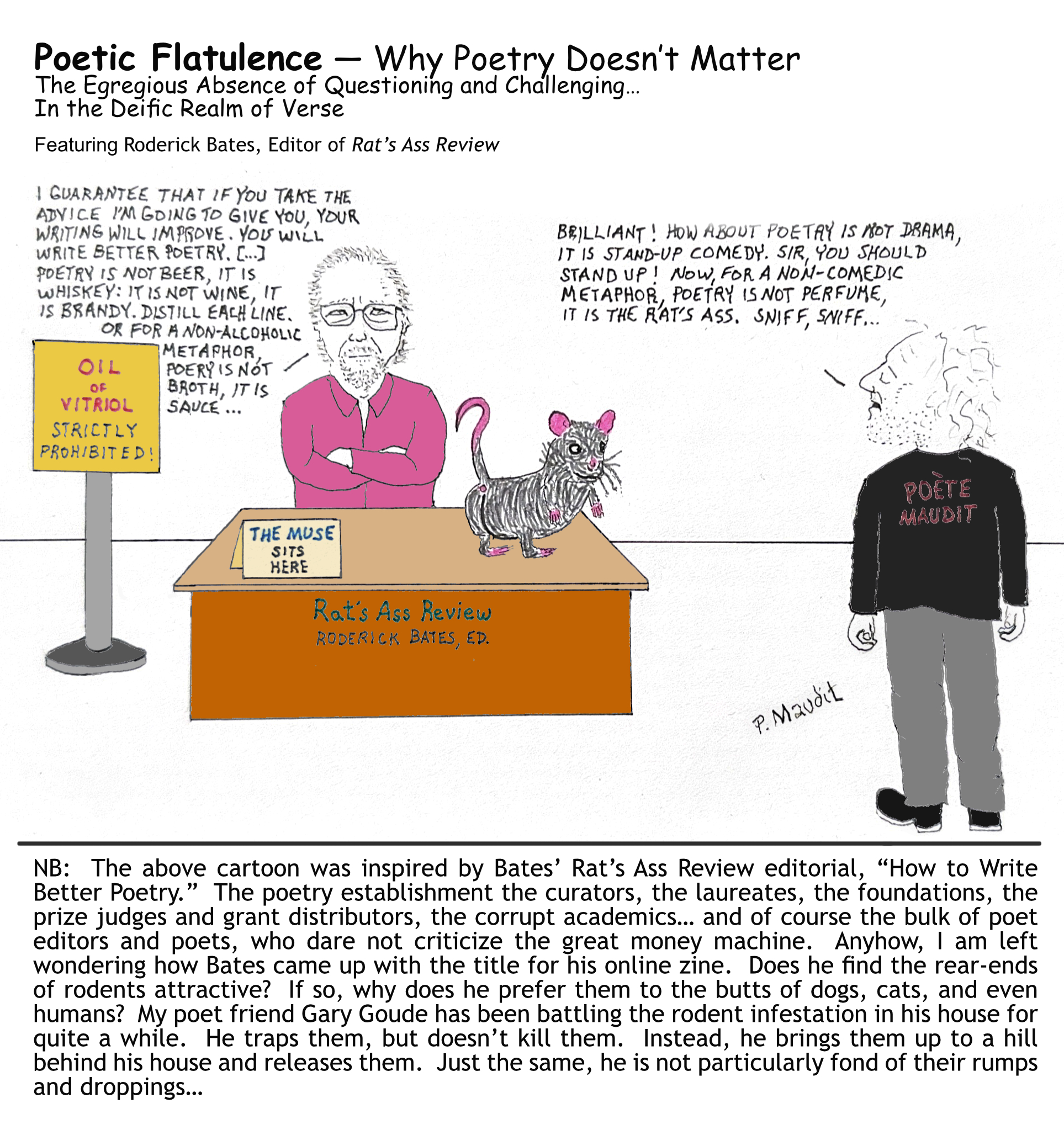
Roderick Bates, Editor of Rat’s Ass Review, states that “Rat’s Ass Review is a poetry journal whose editorial fancies are no more arbitrary than any other; they are simply more overtly so. I publish what I like.” Well, as editor of a different journal, I too publish what I like, but also what I sort of don’t like, especially criticism with my regard and the journal’s. In fact, I not only brook but encourage it! In any case, in a lengthy editorial essay, “How to Write Better Poetry”, Bates argues:
And, if you write, and are not delusional, you know that writing is painful […]. There isn’t much that can be done about the pain; that’s just the way it is.
Well, maybe someone ought to introduce the editor to extra-strength TylenoI! In the realm, his realm, of rodent rear-ends, I must be “delusional” because I’ve been writing for decades… and have yet to feel an iota of pain, physical or mental! How is that possible? Perhaps too many, if not most, writers would likely agree with Bates’ statement, which is not really an original one. The “pain” argument, like the “writing as hard work”one, seems to have become hackneyed, serving the writing industry—the literary established order—by helping to deify poets and writers as hard workers and perhaps even help increase their readership. Ah, but Bates is somehow a master of the art: “I guarantee that if you take the advice I’m going to give you, your writing will improve. You will write better poetry.” But how might the master define “better poetry”? The definition of a sophist is perhaps pertinent here: “A person skilled in elaborate and devious argumentation.” Bates’ elaboration is at antipodes to Thoreau’s dictum: “simplify, simplify.” And so, the editor writes:
Let’s begin with William Carlos Williams’ famous words: “No ideas but in things.” I am not going to tell you what they mean; that would not only violate their direction, but would limit your potential understanding of them. I will say these two things: the dictum has been said to define the direction of post-19th Century poetry, and it is an ideal thing to slip into your pocket or purse, and to hold in your hand in idle moments.
Now, who in their right mind would do that? Workshop poets? How not to dissect Williams’ statement? Indeed, why not both ideas and things? Or why not just ideas? And what might “things” not include in the realm of establishment poets and poetry, if not the satirizing of state poet laureates and the criticizing of the definers of poetry like Bates himself? Yet aren’t those “things”? Likely, for Bates, they are not. Note also that Bates seems to contradict the idyllic statement by arguing: “In a well-crafted poem every word is essential and ideas are tightly packed together.” Ideas! Ah, but Williams had stated “no ideas”! Moreover, as a poetry editor at antipodes to Bates, I quote rare poets who dared go against the machine like, for example, François Villon: “estoit-il lots temps de moi taire ? [should I have kept my mouth shut then?]” And Lord Byron: “I’ll publish, right or wrong:/ Fools are my theme, let satire be my song.” Bates seems to prefer the absence of clarity in the grain of self-glorification, something poets of the establishment, in general, obviously prefer.
Flowery language is not what makes a poem, density is what makes a poem. No matter how conversational the language, a good poem contains more than does prose.
Well, Bates ought to have added to his statement: density, as long as not densely critical of poet and poetry inflators. But poet and poet curator salaries depend on such inflation. “Poetry is not beer,” argues Bates, “it is whiskey: it is not wine, it is brandy. Distill each line. Or for a non-alcoholic metaphor, poetry is not broth, it is sauce.” Well, that actually got me laughing! And so, why not add to Bates’ metaphorical word-salad: poetry is not drama, it is comedy! The editor then argues that all poets should join a poetry workshop.
No, you are not too good to profit from a workshop. The one I am in includes a former state poet laureate, and she gets critiqued just like the rest of us. And no, you are not too delicate to withstand criticism. Or, if you are, you should stop writing and take up Sudoku or dusting.
Good point, but is it simply meant to be hot air? And why does Bates seem incapable like most poets to question and challenge what it really means to be anointed a “state poet” or poet with tenure? Do they discuss that in his workshop? Do they discuss Lord Byron ’s famous quote: “Bob Southey! You’re a poet, a poet laureate,/ […] / ‘A dainty dish to set before the King’” ? Today in America we have “Arthur Sze! You’re a poet, a poet laureate, / […] / ‘A dainty dish to set before the United States Congress’” (see “Poets Laureate of the United States … Government”/). And how sadly rare it is to read such criticisms in the realm of famous poets like Byron! And how difficult it is to find a critic amongst them. Over the years, I have hunted and posted the few examples found.
As for Bates’ “too delicate to withstand criticism” comment, almost all of the poets and poetry editors I’ve criticized over the past few decades were far “too delicate.” One poet editor, for example, responded to my criticism:
Dear Mr. Slone:
I spoke to my father [Todd Moore], the co-editor of our magazine [Outlaw Poetry], and have mutually agreed to retract the offer of accepting an essay by you for print in the next issue. We’re also requesting that future e-mail exchanges between you and myself, and my father and you be terminated as well. Thank you for your time. Best of luck with AD.
Sincerely,
Theron Moore
Co-editor St. Vitus’s Dance.
And another responded:
Silly Slone, I was trained in literary studies during a decade in graduate school with some of the foremost critics of the time. Your idea of criticism, from the shrillness of your rants, excludes any sense of illumination. Please do not contact me again.
Chris Busa, Ed., Provincetown Arts
Kudos to those two poets, for they actually countered the establishment norm of SILENCE IS GOLDEN. Yes, they deigned to respond, though not at all to any of the points made. My lengthy experience highlights the dark reality that the bulk of poets and poetry editors simply do not/will not respond to hardcore (real!) criticism with their regard. How about the editor of Rat’s Ass Review, who offers a free workshop to those he publishes:
And in the interest of promoting our own community, I should add that if you are among the poets chosen to publish in Rat’s Ass Review, you have the opportunity to join our on-line workshop. This workshop is free […]
Not quite sure how limiting the workshop to those who please the editor will result in critical feedback, which the editor argues to support: “If the first workshop you find is full of people who only get together to share cookies and praise, who never say anything critical, keep looking.” To that, he adds:
This next bit of advice might seem a bit selfish, but that’s OK; after all, you are doing all of this for yourself: find a workshop which is made up of people who are better writers than you are. You will tend to rise to the level of those around you.
Like Bates, it seems that perhaps most poets do not realize that “better” is a highly subjective term with regards to poetry. Instead, they open wide and swallow that which the curators present as somehow objective. Few poets will even wonder about the biases of the faceless judges of the Pulitzer, Pushcart, Griffin, etc., etc. The editor then suggests exercising.
Most of us, I suspect, have tried various exercises in hope of luring the muse somewhere near our writing desks.
Now, for some reason I have never done that. Why not? Well, it has always been outside instigations that provoked me to write. In other words, I have never sat down to try to write prior to such provocations. Experiences provoke me to write. In vain, I’ve suggested to some writers that they should write about their experiences. One of them, for example, has had amazing experiences living in a mental hospital and battling with her sister, but refuses to write about them. I’ve even suggested to another that she write something critical about the workshop she attends, but simply refuses to do so. Too many writers just write about anything but their actual experiences, likely because they have had none. Generally, for me, it has been personal experiences with corruption and the corrupt, though also the often vapid statements made by others, that provoke me to write (and cartoon!). Sadly, Bates does not even mention that as a possibility! The writing industry likely thrives on writers writing about anything but… the intrinsic intellectual corruption within its midst. It encourages the production of reams and reams of fluff. Bates encourages:
You probably don’t need to be told how easy it is to go a day, a week, longer, without writing. But you won’t ever be a writer if you don’t write. So get to it!
For me, I’d rather be ostracized into oblivion, than turn a blind eye regarding the inevitable intellectual corruption in the realm of the writing industry. My goal is certainly not that of Bates’ apparent goal to get published and renown. It is far more in line with Orwell’s “Why I Write”: When I sit down to write a book, I do not say to myself, ‘I am going to produce a work of art.’ I write it because there is some lie that I want to expose, some fact to which I want to draw attention, and my initial concern is to get a hearing.
Bates’ exercise suggestions really do underscore why poetry does NOT matter, contradicting former California Poet Laureate Dana Gioa’s essay, “Can Poetry Matter?” The latter incited me to write and cartoon critically. The following are two examples from Bates’ exercises.
Try writing a Clerihew, which is a four line poem rhyming AABB (that’s poetry shorthand for saying that the first two lines rhyme with each other, and that the last two lines also rhyme with each other, but do not rhyme with lines one and two). The first line is the name of some well-known person (or at least ends with that person’s name), the content of the poem is frivolous and pokes good-natured fun at the person, and you get extra credit if the meter is inconsistent and the rhymes are tortured.
Another exercise has become so popular among poets that it has its own name. If you stare long enough at a painting or a piece of sculpture, or perhaps a Grecian Urn, you may wind up writing an ekphrastic poem. To see several such poems that have appeared in Rat’s Ass Review, go here.
Now, how about an exercise that might be career risky, including read Bates’ essay and write a critical counter essay to it. Indeed, that might reduce a poet’s chances of getting published! Bates then suggests, “Show up at Readings, and Read.” Well, how about show up at readings and protest. Hell, I’ve done that on several occasions, including at the Concord Poetry Center and even at the Festival international de la poésie de Trois-Rivières in Québec, as an invited poet. Doing that can create wonderful grist for ones writing (and cartooning!). Bates then suggests: “Just Plain Read.”
Grab a contemporary poetry collection and get an overview of what a wide variety of successful poets are doing.
The question, which Bates and most other poets fail to address, is what precisely the subjective term, “successful,” really implies, if not climbing the ladder by turning a blind eye, conforming, and never openly criticizing—prerequisites for getting published and receiving invitations, awards, grants, tenure and laureate anointments. That is egregiously evident, yet few poets and writers will ever contemplate it. Yet another of Bates’ suggestions begs for dissection:
If you are a formal poet, don’t just read sonnets and quatrains and sestinas. Pick up a copy of The Outlaw Bible of American Poetry and scare the hell out of yourself. You may not suddenly begin to write eerily noir prose poems, but your next villanelle might have an edge or a bite that you may find new and exciting.
Well, the link doesn’t work, (now fixed — thanks, Dr. Slone) so I checked out theWikipedia write-up and Kirkus review. A number of the poets in the book became academics like Ginsberg and some are black racists like Baca and laureates like Harjo, who I dubbed “Poet Laureate Cog Supreme of the Poetry Machine.” So, obviously it is a farce to label many if not most of the poets in that book as “outlaws”! And of course I’d brought that to the attention of the editor of the Outlaw Poetry zine (see the response above). Why, one must wonder, do educated poets like Bates seem incapable of questioning and challenging that which is spoon fed to them?
Finally, contrary to Bates, I’d advise, more than anything else, that poets stand up against the machine, those hands that feed invitations, publications, grants, etc. Make poetry really matter! Don’t be so obsessed with, in Bates’ words, “getting your poems out there” and gaining renown! Rather work at a burger joint, than trying to make money off of writing by inevitably caving in to the ole see-no-evil, speak-no-evil, write-no-evil modus operandi… of “success.” Now, I wonder how Bates came up with the rather unpoetic title for his poetry zine. Does he somehow like the rear-ends of rodents? If so, why does he prefer them over the butts of dogs, lions, and/or humans? My poet friend Gary Goude has been battling the rodent infestation in his house for quite a while. He traps them, but doesn’t kill them. Instead, he brings them up to a hill behind his house and releases them. Just the same, he is not particularly fond of their rumps…
Post Scriptum:
To Roderick Bates, Editor of Rat’s Ass Review:
Please consider publishing in your review, my satirical essay, “Dissecting the Rat’s Arse.” Your readers might learn from it. Perhaps it would also help them modify, even just a little, their writing direction. Anyhow, thank you for the inspiration! Hopefully, you will respond… this time.
Post Post Scriptum:
Hi,
If you would send me a brief bio, I would like both your critique of RAR and the accompanying artwork for the Fall/Winter 2026 issue of Rat’s Ass Review, for publication on our website, perhaps in a print edition, and with luck, in an ebook edition. All other rights remain with you.
Is this OK with you?
Rick
Reviewers’ Bios:
Richard Collins, abbot of the New Orleans Zen Temple, lives in Sewanee, Tennessee. His books include In Search of the Hermaphrodite: A Memoir (Tough Poets, 2024), Stone Nest (Shanti Arts, 2025), and Cartoons for the Chaos (forthcoming from Shanti Arts). Special features and nominations (Pushcart, Best of the Net, Best Spiritual Literature) appear in Clockhouse, Philly Chapbook Review, Shō Poetry Journal, Willows Wept Review, and Seventh Quarry.
Before his current exile in Tennessee, New Yorker David M. Harris‘s first career was in book publishing, as an editor, agent, and copyeditor. He also worked for a while in film production before getting his MFA and starting a career teaching college English. His poetry has appeared in various journals. His first collection of poetry, The Review Mirror, was published by Unsolicited Press in 2013. He is also the author of Democracy and Other Problems, an essay collection; Bill, the Galactic Hero: the Final Incoherent Adventure (a novel with Harry Harrison); numerous magazine articles; several published short stories; and two produced screenplays.
Peter Mladinic’s most recent book of poems, The Whitestone Bridge, is available from Anxiety Press. An animal rights advocate, he lives in Hobbs, New Mexico, United States.
G. Tod Slone Founding editor of The American Dissident, a journal of literature, democracy, and dissidence. Doctoral degree from the Université de Nantes (France). Taught at a number of colleges, including two HBCUs. Never got tenure; always openly criticized my intellectually corrupt academic bosses. Photographer of northern beauty (Labrador, Newfoundland, Québec).
John Yamrus is widely recognized as master of minimalism and the neo-noir in modern poetry. In a career spanning more than 50 years as a working writer, he has had nearly 4,000 poems published in books, magazines and anthologies around the world. His writing is often taught in college and university courses. Three of his more than 40 books have been published in translation. Fittingly, the 75 year old’s newest book is a volume of his signature minimalist poetry called AIN’T DONE YET.